Home Blog Page 151

Malicious Bot Attacks Surge Drastically; 50% of Businesses Affected in Last 12 Months

BazaCall BazaLoader

A research from fraud prevention and identity trust services provider Kount revealed the current state of malicious bots and their impact on businesses. The “2020 Bot Landscape and Impact Report” highlighted how businesses are using good bots against  malicious bots. The evolving bots are becoming difficult to detect and block, with traditional solutions relying on blunt force protection, perimeter security, web access firewalls, and content delivery networks.

Key Highlights

  • 81% of businesses very often deal with issues related to malicious bots.
  • More than half of businesses encountered more than 50 bot attacks in the last 12 months.
  • 80% say there has been an increase in financial loss within their organization because of more complex and sophisticated bot attacks.
  • One in four say a single bot attack has cost them $500,000 or more in the past year, and two in three say a single attack has cost $100,000 or more.

Gary Sevounts, CMO, Kount, said, “The new 2020 Bot Landscape and Impact Report reveals critical gaps in the current state of fraud detection with traditional solutions, as nearly nine in 10 businesses are saying that current options aren’t effective for the increasingly complex and sophisticated attacks of today. With digital acceleration at an unprecedented pace, businesses are encountering increasing bot attacks with more consequences, including brand reputation damage. This demonstrates that event-based protection at every step of the customer journey is critical to success.”

Rise of Botnet Exploit Activity

A similar research from Nuspire found an increase in botnet and exploit activity in Q2 2020 by 29% and 13% respectively, which is more than 17,000 botnet and 187,000 exploit attacks a day. While attackers targeted remote work technology at the source to obtain access to the enterprise in Q1 2020, the research found hackers changed their attacking tactics to leverage botnets to obtain a foothold of the targeted network systems. Read more.

Microsoft’s Shield Against Password Spray Attacks Just Went a Notch Higher

common password of 2021,Password Protection, password spray attacks, Microsoft accounts passwords

It is observed that threat actors popularly use the password spray attack, not because of its high success rate (as per Microsoft, only 1% of these attacks are successful) but because it largely goes undetected for a substantial amount of time. It gets lost in the daily clutter of failed login attempts, especially in the current scenario of remote working. However, even with a low success rate, it’s worth noting that password spray attacks account for more than a third of account compromise in organizations worldwide. Thus, to further fortify the defenses against them, Microsoft’s Azure AD has now introduced advanced password spray detection that will act as an additional shield against password spray attacks.

Is Password Spray Another Term for Brute Force Attack?

No, both are different. Although password spray is similar to a brute force attack, the striking difference between the two is that brute force is a precisely targeted attack. The threat actor(s) go after specific users and cycle through as many passwords as possible, either by using a commonly used passwords dictionary or by implying social engineering tactics. The latter involves thorough research of the targeted person to check if they can guess the user’s password from their social behavior and information.

password spray attack
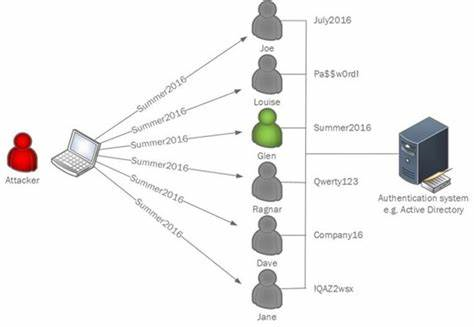
Password Spray using one password across multiple accounts; Image Credit: Microsoft

In password spray attacks, threat actor(s) obtain a list of accounts of the targeted organization and attempt to sign-in into all of them in a single go using a small subset (only one or two passwords daily) of the most popular, or most likely, passwords until they get a positive hit.

Evolution of Password Spray Detection

Initially, Microsoft, in its Azure Active Directory (AD), used only an investigative approach, which was based on constant monitoring. It detected a single password being attempted against hundreds of thousands of usernames from multiple IPs across the globe and informed the respective organizations of a malicious attempt of breaking in. But now Microsoft has gone a notch higher and adopted a more heuristic approach based on the learnings from its previous model, which was almost 98% successful as per the tech giant.

Related News:
Microsoft Tops the Chart for Being Most Imitated Brand for Phishing Attacks

Microsoft said, “Our data scientists started researching the use of these patterns (the ones detected from the previous approach) and additional data to train a new supervised machine learning system. We incorporated IP reputation, unfamiliar sign-in properties, and other deviations in account behavior. The results of this research led to this month’s release of the new password spray risk detection. This new machine learning detection yields a 100% increase in recall over the heuristic algorithm described above meaning it detects twice the number of compromised accounts of the previous algorithm. It does this while maintaining the previous algorithm’s amazing 98% precision — meaning if this algorithm says an account fell to password spray, it’s almost certain that it did.”

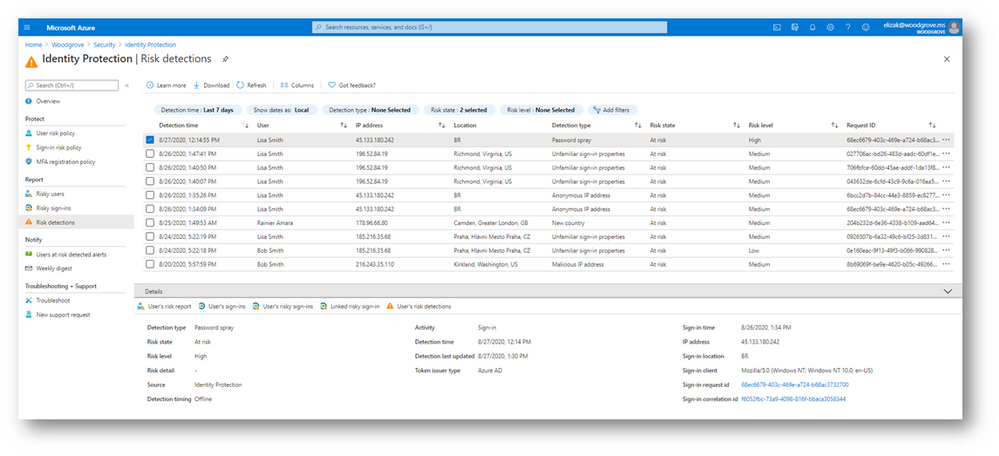
This new detection will be available for Azure AD Identity Protection customers in their Identity Protection portal and APIs, respectively. The following screenshot provides a sample of the new risk detection:

Azure AD Identity Protection
Image Credit: Microsoft
Related News:
CISA Advises Enterprises to Patch Two Critical Microsoft Vulnerabilities
Microsoft Offers $100,000 Bounty to Hack Its Azure Sphere Linux IoT OS

Forter and FreedomPay Unite to Boost E-Commerce Cybersecurity

e-skimming attacks , Chinese e-commerce scammers

Forter, an e-commerce fraud prevention services provider, partnered with payment services platform FreedomPay to combat e-commerce scams and frauds. The new alliance forms a network for merchants and banks to block fraudsters online and enable legitimate consumers to operate freely. This will help resolve the issue of multiple players, like an online merchant, credit card issuer, and the banker, involved in each online transaction using different fraud solutions. Through the joint network, merchants can confidently accept users they have never seen before.

The partnership integrates Forter’s identity-based fraud prevention solutions with FreedomPay’s Next Level Commerce platform to find fraudulent activities in real-time, throughout all consumer experiences online.

The e-commerce industry recorded a significant growth during the pandemic, following the lockdown restrictions. This resulted threat actors to target online shoppers. Forter stated that online transaction volumes for new users increased by more than 2X since the start of COVID-19, however, the new users are 5-7X more likely to be declined due to lack of data with legacy fraud prevention systems.

Liron Damri, Co-founder and President of Forter, said, “Our coalition of merchants, payment providers and banks fighting fraud together is a huge step forward in global fraud prevention. With over $200 billion in online transactions and over 800 million trusted users, we enable our coalition members to be way more effective in fighting fraud and growing the business with confidence.”

Chris Kronenthal, President and CTO at FreedomPay, said, “Fraud prevention continues to be a pain point for merchants, and together FreedomPay and Forter provide a world-class solution. Forter’s fraud prevention capabilities protect merchants on FreedomPay’s Commerce Platform and ensure that only legitimate transactions are approved — this not only increases the volume of transactions we are able to process, but also helps to build brand loyalty by providing an optimal consumer experience.”

55% Consumers Believe Companies are not Doing Enough to Protect Their Data Online

Nearly Half of Global Consumers Affected by Data Breaches

Data breaches are unfortunate events for any business. Apart from financial damage and heavy fines, data breaches also cause a severe impact on employees’ and customers’ data. According to a new research from OpSec Security, 48% of consumers globally expect to be hit by a data breach in the future, while 30% said they have already suffered a data breach attack once – an increase of 7% compared to 2019. The research also found that 46% of data breach victims have been contacted by brands about their data being compromised two to five times. This resulted in 55% of consumers to believe that companies are not doing enough to protect their personal information.

With cyberattacks on e-commerce businesses increase in scale, consumers are concerned about using their debit/credit cards online. Over 47% of consumers are worried about paying online due to fear of personal information theft (62%), scammers stealing their money (58%), and identity theft (57%).

Bill Birnie, SVP and GM of OpSec Security’s Online Division, said, “The frequency which data breaches are occurring is leaving many consumers desensitized. In fact, our research found 30% of those who have been the victim of a data breach were unsurprised when they found out about it. However, this desensitization is often also paired with the expectation that organizations will have the protections in place to safeguard personal data and credit card details, and that the consumer will be reimbursed for any resulting monetary losses. Despite this, large-scale data breaches are continuing to damage brands, as 64% of victims have lost trust in the company or brand that lost their data.”

“As many consumers now run much of their lives online following the impact of COVID-19, businesses must be more proactive about cybersecurity and online consumer protection than ever, with solutions in place to stop these threats in their tracks. Failing to do so can be extremely costly not only in terms of compliance with data management regulations, but also by customer loss. 28% of consumers who have lost trust in a company due to data breaches say they won’t shop with the brand again,” Birnie added.

Organizations Need to Secure Their Endpoints with Smarter Solutions

endpoint solutions

Organizations are being attacked at an increasing rate with breaches causing significant financial and reputational consequences. In the State of Endpoint Security Risk Whitepaper, nearly two-thirds (64%) of respondents reported that their company had experienced one or more endpoint attacks over the past 12 months that successfully compromised data assets and/or IT infrastructure. This is a 17% increase from the previous year’s research (54% of respondents).

By Michelle Salvado, VP & GM Endpoint Security, FireEye

A number of factors contribute to this rise of attacks; from the increase in the number of threat actors to the sophistication of the attacks, to the widening attack surface. Financial gain is still the most common motive behind data breaches, but there has been a rise in breaches associated with government and corporate espionage —  carried out by both criminal and government-sponsored groups. These groups have become more sophisticated, moving away from brute force methods and viruses, more often using social and personal attacks, such as phishing, to establish a foothold and then worm their way into an organization. With the growth of BYOD, the proliferation of mobile and cloud, and new IoT advancements, attack routes are ever-increasing.

Traditional defenses are inadequate today

Traditionally, cybersecurity departments would deploy desktop anti-malware to stop threats. These solutions compare an item, such as an attachment or URL, to an internal database of threat signatures. A new signature is created for a threat after it has caused issues (because an organization has been hit by it already). A file or URL is traced to a specific compromised site that is updated as a threat source, it is blocked and then the organization’s endpoints are updated with the new threat signature. This can also be the case for a known good location, which can be “whitelisted” or allowed based on its reputation. As necessary as it is, all of this takes a tremendous amount of time and resources. Sadly, as soon as a good “whitelisted” site is given a clean bill of health, it can be hacked and become a source of malware, indicating that static files are continually out of date.

Historically, these have worked well enough, if the endpoints are able to be updated frequently with new signature databases. In the last few years, new threats and new methodologies have been used to attack at a far faster rate than systems could be updated. Threats were created and targeted to bypass their existing identity base, using social or email campaigns, such as phishing or identity impersonation. Consequently, the percentage of threats they could block has significantly diminished.

So, the problem is not whether a site that relies on these traditional models will be penetrated; it’s when and whether anyone will discover it before it causes damage.

This situation is much like taking a conventional passenger van and putting it in a drag race against a Formula One racer. The van would be sorely outclassed against its competitor from start to finish. In effect, the F1 could make multiple laps before the van finished its first lap. This doesn’t mean the van has no value; it certainly does. But if it’s expected to play in this new field, it needs new capabilities. Unfortunately, even if we can make it faster, it still has a basic design that will always limit its top speed, no matter how much it is modified. A full redesign and new thinking of the van would be required before it would even have a chance to compete.

Endpoint Security

Closing the gaps

Essentially, there is a gap between conventional endpoint security methods and new-age technology to block advanced threats, dynamic detection that goes beyond signatures, and whitelists, which needs to be closed. Responding to threats requires an understanding of the attackers, their tools, techniques, and procedures, not just cataloging threats. Doing this requires analysts to use sophisticated tools to inspect and analyze all threats in real-time across an entire organization, from its core to all its endpoints.

Newer, advanced, and flexible endpoint protection, often labeled “next-generation” endpoint security solutions, can combat these threats by providing both advanced endpoint protection (EPP) — and newer endpoint detection and response (EDR) capabilities to find the breaches quickly when they occur. Some of the prime advantages of this next-generation endpoint security solution include:

  • Defending the endpoint with a defense in depth mindset. Start with the best of legacy system signature-based detection to find and block common malware. Then, add in new capabilities, such as behavioral-based and machine learning engines to find the advanced threats.
  • Finding the threats that have bypassed the advanced protection, advanced detection using intelligence-based indicators of compromise. Once found, inspecting and analyzing the breach to obtain a complete activity timeline or forensic analysis and gather details on any incident.
  • Conducting complex searches of all endpoints to find known and unknown threats, isolate compromised devices for added analysis with a single click, then deploy fixes across all endpoints.

Conclusion

Even with all these capabilities to address the wide variety of threat types and methodologies organizations are constantly facing, integrated capabilities are the key to providing an effective defense. Next-generation endpoint security encompasses comprehensive endpoint visibility and threat intelligence, which enable analysts to adapt their defense based on real-time details to deploy informed, tailored responses to the threat activities. This must be delivered within an integrated and automatic threat detection and prevention system that is tightly coupled with threat intelligence and detailed threat visibility. Automation can address the overwhelming volume of threats, along with integrated threat intelligence and endpoint visibility, allow intelligence analysts to gather details on high-risk threats and quickly determine an effective response and deploy across the entire organization.

With this next-level of smart, comprehensive and integrated endpoint defense solutions, security professionals are enabled to block the common and advanced threats and find and respond to breaches when they do occur. Security professionals are no longer driving an outdated van trying to keep up with the F1 racer, but rather an advanced, rebuilt racer specific to this new environment.


About the Author

Michelle Salvado is the Vice President & GM for Endpoint Security at FireEye. She is an accomplished technical leader with deep knowledge of software engineering execution, operations, agile transformation, adoption, process implementation and continual improvement. She also possesses a strong focus on coaching leadership in an effort to achieve enterprise agility and has proven experience in building and managing software engineering and services organizations.

Disclaimer

Views expressed in this article are personal. The facts, opinions, and language in the article do not reflect the views of CISO MAG and CISO MAG does not assume any responsibility or liability for the same.

Is Your Endpoint Device Secure? Take our Endpoint Security Survey and win exciting goodies. Don’t miss out! Take Survey Now!


A Tsunami of Ryuk Ransomware Attacks Hits U.S. Hospitals

Ryuk ransomware targeting hospitals

The latest string of Ryuk ransomware attacks on multiple U.S. hospitals is a cold reminder of a similar methodology implied by WannaCry operators back in 2017. The cybercriminals who are reportedly from the Eastern European region have already targeted multiple hospitals in Oregon, California, and New York. The extent of disruption can be gauged from the fact that six hospitals targeted on the same day have already been forced to go offline and revert to pen and paper to continue operations.

Following the tough task of maintaining cyber safety and security from such a penetrative and destructive form of cyberattack, CISA, FBI, and DHS, have jointly issued a red alert to all hospitals and health care institutes across the U.S.

 Key Highlights 

  • CISA, FBI, and DHS (also known as HHS) have found that malicious cyber actors are targeting the HPH Sector with Trickbot malware, often leading to a Ryuk ransomware attack, data theft, and the disruption of health care services.
  • The so-called UNC 1878 hacking group is said to be behind these attacks.
  • Multiple hospitals in Oregon, California, and New York, have already been hit with a wave of new Ryuk ransomware variant forcing them to go offline.

The Big Game Hunting

GRIM SPIDER, a subset of WIZARD SPIDER cybercrime group, had been operating the Ryuk ransomware since August 2018, targeting large scale enterprises for a high-ransom return. This methodology of targeting the bigger enterprises is called “big game hunting,” which the GRIM SPIDER seems to have successfully employed ever since. Their operations were always limited to banking and financial institutions in the European region, however, off late, there seems to be a shift in the operational geography for the Ryuk ransomware operators. They have zeroed down on the health care sector in the U.S. which is currently highly overworked, vulnerable, and more valuable than the other sectors; as many hospitals and institutes are actively researching and testing probable vaccination candidates during the ongoing COVID-19 pandemic.

Related News:
Sopra Steria Confirms Being Hit by New Variant of Ryuk Ransomware

Adam Myers, SVP for Intelligence at CrowdStrike said, “The recent Ryuk attacks on U.S.-based hospital systems indicate the continued proliferation and evolution of ransomware. Among the 25 adversaries CrowdStrike tracks that are engaged in Big Game Hunting (a.k.a. Enterprise Ransomware), we’re seeing two categories emerge: ransomware-as-a-service groups that adopt a revenue-share model, and closed groups, such as WIZARD SPIDER’s TrickBot, who fully manage ransomware operations and reap all the benefits. We have also witnessed a disturbing trend in the last 18 months in which adversaries are moving beyond encrypting files to exfiltrating data and threatening to release it if demands are not met. In fact, in some cases the attackers demand two ransoms – one to delete the data and another to decrypt it.”

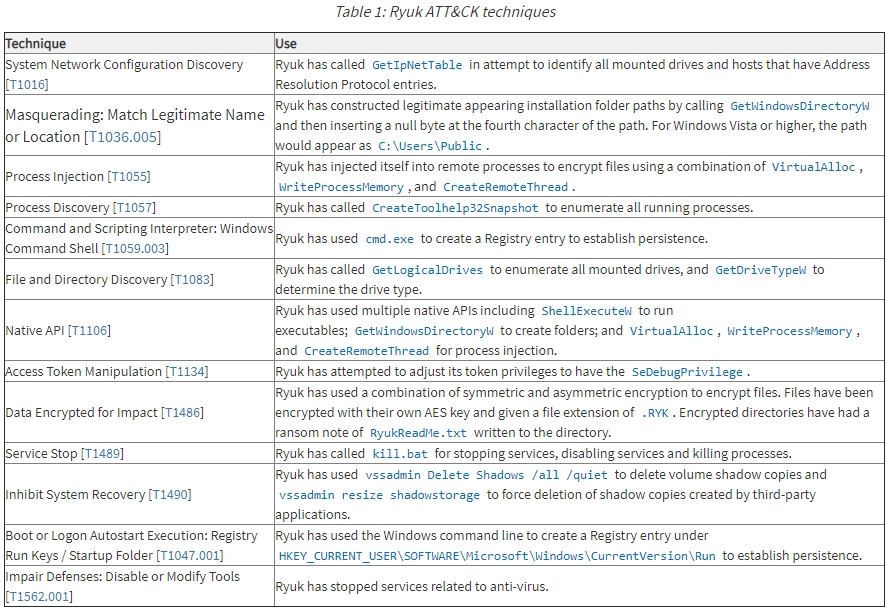
According to MITRE, Ryuk uses the following ATT&CK techniques:

Ryuk Ransomware targeting US hospitals
Details as per MITRE ATT&CK Database

CISA Says…

In its advisory, CISA has actively urged the HPH sector to patch its operating systems and implement network segmentation as primary mitigation steps against such ransomware attacks. It also recommended not paying ransoms, stating that it may encourage threat actors to target additional organizations.

To have a quick and effective incident response in an event of a ransomware attack, CISA urged organizations to “Regularly back up data, air gap, and password-protect backup copies offline.” It added, “Implement a recovery plan to maintain and retain multiple copies of sensitive or proprietary data and servers in a physically separate, secure location.”

Related News:
Ryuk Ransomware Campaign Targets Port Lavaca City Hall
North Korea Behind ‘WannaCry’ NHS Cyberattack: UK

Vulnerability Alert: NCSC Warns U.K. Organizations About SharePoint Flaw

NCSC

The National Cyber Security Centre (NCSC) in the U.K. has warned about a new remote code execution vulnerability (CVE–2020–16952), which affects Microsoft’s SharePoint products. In a security report, the agency stated that the vulnerability exists due to a validation issue in user-supplied data, which could allow an attacker to run arbitrary code and obtain admin access on affected installations of the SharePoint server.

“This vulnerability can be exploited when a user uploads a specially crafted SharePoint application package to an affected version of SharePoint,” the NCSC said. (Pullout quote)

The affected versions include:

  • Microsoft SharePoint Foundation 2013 Service Pack 1
  • Microsoft SharePoint Enterprise Server 2016
  • Microsoft SharePoint Server 2019

Although the NCSC had noticed multiple exploitations of SharePoint vulnerabilities, it clarified that SharePoint online, which is a part of Office 365, is not affected by the flaw.

Mitigation Measures

The agency recommended users to apply security updates to mitigate the exploitation of the vulnerability and remediate the affected SharePoint products. It also listed certain protective measures for mitigation of other vulnerabilities, such as:

  • Protect your devices and networks by keeping them up-to-date. Use the latest supported versions, apply security updates promptly; use antivirus and scan regularly to guard against known malware threats.
  • Prevent and detect lateral movement in your organization’s
  • Set up a security monitoring capability so you are collecting the data that will be needed to analyze network intrusions.
  • Review and refresh your incident management processes.

Related story:

U.K. NCSC Launches New Vulnerability Reporting Toolkit

CISO MAG is running an Endpoint Security Survey for its year-ender issue. Spare five minutes, take our Survey, and win some exciting goodies. Don’t miss out! Take Survey Now!

Sweden’s Gunnebo Suffers Security Data Leak

Sweden, security data leak

Sweden was hit by a massive security data leak in August. As per Dagens Nyheter, a local media in Sweden, the security data leak included 19GB worth information and contained nearly 38,000 files. These files contained critical security information like bank vault floor plans, alarm systems, and security arrangements of the Swedish parliament.

 Key Highlights 

  • The data leak occurred during a cyberattack on a third-party service provider, Gunnebo Group, in August.
  • Nearly 19GB of data consisting of 38,000 critical files was stolen in the cyberattack.
  • The leaked data included bank vault layouts of at least two German banks and the surveillance camera feed of SEB Bank in Sweden.
  • Gunnebo informed the Swedish Security Service, Säpo, about the hack in August itself.

Headquartered in Sweden, Gunnebo is a multinational company providing security products, services, and software to varied sectors including nuclear power plants, healthcare, finance, and hospitality, among others. Thus, the hack, which the company said was “well organized,” was targeted towards gaining confidential information of its high-profile public domain clientele.

Related News:
Norwegian Parliament Hit by Cyberattack; Emails of Members Compromised

Among the leaked documents, details of several security arrangements of the Swedish parliament and confidential plans of the Swedish Tax Agency’s new office on the outskirts of Stockholm are also present. Gunnebo Group CEO, Stefan Syrén, was quoted as telling the local media, “It’s of course unfortunate that we’ve had a theft of data. We are now reviewing the material, and in cases where there is sensitive information involved, we are contacting the client. We can only speculate on what the target of the attack was, but as we cannot rule out, that it was an attempt at industrial espionage. It has been important to follow the regulations and we have therefore decided to inform Säpo.”

Related News:
Botched data backup in Sweden


Financial Sector is Most Concerned About Cybersecurity Risks

Financial Sector

According to a survey from cybersecurity firm Netwrix, organizations in the financial sector are most concerned about security incidents and exhibited severe changes in their cybersecurity priorities. The survey “2020 Netwrix Cyber Threats Report” highlighted how the pandemic and subsequent work-from-home initiatives changed the security threat landscape.

The survey revealed that VPN exploitation increased, stating that 94% of respondents considered it as a top security risk. Supply chain compromise incidents surged from 50% to 97%. Human errors were the most commonly reported security incidents, as 48% of respondents said users fell for phishing attacks in the first few months of the pandemic, 31% suffered improper data sharing, and 28% experienced incidents caused by admin mistakes.

Other Findings:

  • Nearly, 30% of financial organizations feel they are at greater cybersecurity risk now than they were pre-pandemic. The majority (64%) are concerned about both more frequent cyberattacks and the security gaps caused by remote work
  • 14% of respondents reported a supply chain compromise since the pandemic began. Though this event is seen as a critical risk by nearly all financial organizations now, the victims were particularly slow in detecting it: 76% needed days, weeks, or months
  • Insecure data sharing took the longest to detect: 51% required days to flag the incident, while 19% needed weeks and 11% required months.

“In the financial sector, concern about malicious access to sensitive data skyrocketed in the first few months of the pandemic, more so than in any other vertical. However, the majority of incidents at financial organizations during that period were actually caused by the human element. To minimize both malicious and inadvertent data loss, this industry should heed cybersecurity experts, who recommend combining regular end-user training with flexible solutions that can proactively identify and protect sensitive data and spot attacks before they become breaches,” said Ilia Sotnikov, VP of Product Management at Netwrix.

Why MSPs are adding “S” to their portfolio

Adding an “S” to the (MSP) Managed Service Providers has of late become a more common affair. Several Managed Service Providers (MSPs) are making the shift toward becoming a Managed Security Service Provider (MSSP). While most MSPs are providing security in the form of endpoint management, patching, firewalls, and anti-malware solutions, the cybersecurity threat landscape calls for even broader levels of protection. The end goal for many of these MSPs is to develop a well-managed security practice that provides advanced cybersecurity services and solutions, especially for testing times like today.

By Augustin Kurian, Senior Feature Writer, CISO MAG

With COVID-19 opening a pandora’s box of cyberthreats, a resurgence in the MSSP marketplace was also anticipated by several experts. In fact, the global Managed Security Services market is projected to grow from US$31.6 billion in 2020 to US$46.4 billion by 2025. That’s a compound annual growth rate (CAGR) of 8% during the forecast period, according to Markets and Markets. An earlier report by  “ConnectWise SMB State of Cybersecurity” also pointed out that even SMBs are now relying on managed service providers for cybersecurity. One of the most effective methods to shift from MSP to MSSP is by partnering with key vendors, providers, and true-MSSPs.

Related story: MSSP Shopping: Use your corporate AmEx wisely

To understand deeper into the shift from MSP to MSSP, CISO MAG reached out to DefenTec. DefenTec recently expanded from an MSP to MSSP and integrated KeeperMSP into the company’s portfolio of solutions. German Saldivar, the CEO and Security Analyst at DefenTec, spoke to CISO MAG about the shift to MSSP and why the company chose Keeper.

Early in his career, German worked as a System Administrator, which allowed him to develop his skills and knowledge in IT; he later went on to work for NRG Energy, which ignited his curiosity about corporate IT security. Years of system administration and seeing how vital security is to business, inspired him to start his own company focusing on small business security.

MSP to MSSP

What primary factors influenced DefenTec’s decision to expand from an MSP to MSSP? How have DefenTec’s business priorities shifted as a result of the expansion?  

In general, transitioning from an MSP to MSSP was the logical next step for our company to meet the changing IT landscape and offer proper security to ensure people and systems are safe, secure, and compliant. As our customer base grew and offered their employees more remote work capabilities, so did the chances of a breach or cyberattack. Because of this, we sought to expand our services to adapt to our customers’ needs on all fronts quickly.

A recent report centered around the global state of MSPs found 34% of MSPs indicating cybersecurity as a major pain point (compared to 30% in 2019). Coupled with the business difficulties associated with COVID-19, what other types of pain points DefenTec encountered the last few months? 

Home networks are a significant issue with the current remote work due to COVID-19. Most people do not understand the equipment needed for a fast, secure, and reliable network. Most residential homes have a router trying to do the job of multiple components in a business network. Business networks consist of a firewall, managed switches, access points, failover internet, and battery backup in case of a power outage.

On the topic of cybersecurity, since DefenTec integrated KeeperMSP into the company’s portfolio of solutions, how has it been? Why do you think managed service providers choose KeeperMSP? 

In short, we all love KeeperMSP. Our internal team loves how the platform supports custom branding when presenting the add-on feature to customers, and our customers rave about Keeper’s security audit score that provides them with a visual to help them better understand their internal password management posture. Additionally, we’ve seen significant productivity since we’ve implemented Keeper, as all the data is accessible on one platform and our team knows where everything is in order to properly streamline workflows. Plain and simple, KeeperMSP is an easy to use product designed for MSPs. No other password manager has a streamlined interface that provides user prompts to help guide customers through whatever process they need to do. Along with this, the platform serves as an additional revenue stream for our company, as we are able to mark up each subscription we sell to clients. No MSP or MSSP can go wrong if they choose KeeperMSP as their password management software of choice.


Augustin Kurian
About the Author 
Augustin Kurian is part of the editorial team at CISO MAG and writes interviews and features.


Is Your Endpoint Device Secure? Take our Endpoint Security Survey and win exciting goodies. Don’t miss out! Take Survey Now!