Home Blog Page 150

Are We Really Out of the Maze? The Ransomware Gang Announces Retirement

Maze Ransomware Gang Retires

The infamous Maze ransomware gang, which has over the years caused chaos and attacked various MNCs, has surprisingly announced its retirement effective November 1, 2020. In a press release, the Maze ransomware group announced its retirement for the time being; however, it promised to be back.

Look Back at Maze Ransomware

The Maze ransomware, which was previously known as “ChaCha ransomware,” was discovered by a malware intelligence analyst, Jerome Segura, in May 2019. Upon its discovery, the ransomware acted just like other traditional ransomware: It encrypted files on the infected systems and demanded a ransom in return.

However, the operators soon realized that this was not a full-proof method to get money in return. Thus, from the last quarter of 2019, the Maze Team introduced a new tactic to compel their victims to pay the ransom. They started downloading critical data and used it to leverage the negotiations. They would threaten their victims to make the data public on the darknet and open internet forums. In some cases, they even threatened to host open auctions. This notorious act inspired other ransomware gangs like Sodinokibi, Nemty, REvil, and DopplePaymer.

Related News:

Sodinokibi Operators Threaten to Hold ‘Online Auction’ of Madonna’s Stolen Data

Not a Hoax! REvil Ransomware Operators Launch Auction Website

Maze even created a Maze ransomware website “Maze News,” where they published the data of non-paying victims and issued press releases for people who followed their activity.

Since then, the Maze Team has successfully attacked many known and large-scale organizations such as City of Pensacola, Cognizant, LG Electronics, and Xerox.

Related News:

Cognizant Suffers Maze Ransomware Attack; Services Disrupted

Early Retirement

With such a success rate, it is hard to believe that its operators are calling it a day. As per a press release (as shown in the image below), the Maze Team announced, “The Project is closed.”
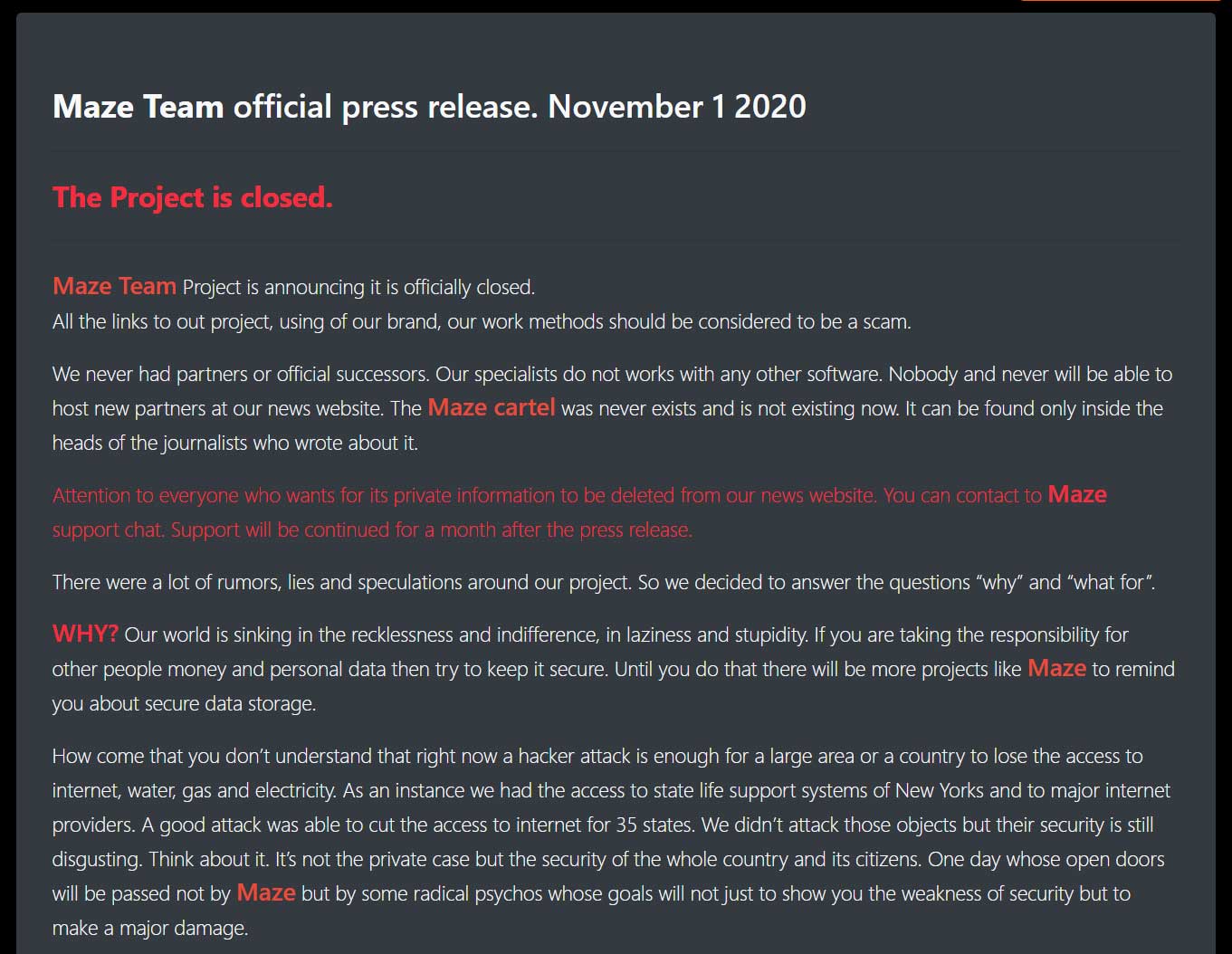
Maze Ransomware Retires
Maze Press Release

They issued a clarification stating that the gang members do not have any other associations and did not work as Maze Cartel, as reports have suggested.  Besides, the gang also justified their acts by answering the question, “What for?”

They said,

“Our world is turning into digital detention camp. Ten or fifteen years and nobody will be able to step aside the system without the fear to lose its social status. Without that social status you won’t be able to make purchases or get the social benefits. The first sign was the bitcoin. The digital currency existing only inside the digital world. After some time, it will allow its owners to rule the world and to crash the economy of other countries as the gold and currency reserves are not converting into bitcoin.

You are calling the ones who are killing your mind as your friends and support. And you also calling the ones who are showing you your weakness as the foes and mobsters. The modern world is confusing the cause and the effect, the good and the evil.

Think about it. Try to prevent it. You think that the modern world is a hell. But it’s just coming, and you are doing much for it.”

Although the Maze ransomware gang announced its retirement with immediate effect, they have asked their victims to contact them within a month, from the time the statement has been issued, for any deletion of private data from their news site.

Experts believe this is not the end of the road for the Maze ransomware gang though. In its closing notes, Maze said, “We will be back to you when the world will be transformed. We will return to show you again the errors and mistakes and to get you out of the Maze.”

So, it is just a matter of time before we get back in the MAZE.

Related News:

A Tsunami of Ryuk Ransomware Attacks Hits U.S. Hospitals


MicroWorld and CERT-In Collaborate to Enhance Overall Cybersecurity in India

U.S. and Australia to Jointly Develop Cyber Training Platform

Cybersecurity solutions provider MicroWorld Technologies announced that it has signed a Memorandum of Understanding (MoU) with the Indian Computer Emergency Response Team (CERT-In) and Ministry of Electronics and Information Technology (MeitY) for a cybersecurity collaboration. Both Microworld and CERT-In will work together to mitigate the evolving cyberthreats and further enhance the overall cybersecurity posture in the country.

As per the MoU, MicroWorld will facilitate cooperation for detecting latest cyberthreats like malware/botnet attacks. CERT-In will also provide a platform on its “Cyber Swachhta Kendra” (Botnet Cleaning and Malware Analysis Centre) website for users to access MicroWorld’s eScan antivirus bot removal toolkit, which enables users to scan their Windows-based systems and prevent viruses like adware, spyware, and other forms of malware. The Cyber Swachhta Kendra is a part of the Government of India’s Digital India initiative operated by CERT-In.

Sanjay Bahl, Director General, CERT-In said, “As the complexity, frequency, and sophistication of malware continues to increase impacting the end user digital devices, there is a need for appropriate tools in the hands of citizens to safeguard themselves. The eScan tool from MicroWorld will help towards the vision of making India cyber swachh and build technical capacities within the country while safeguarding citizens from malware threats.”

Govind Rammurthy, Managing Director and CEO of MicroWorld Technologies, said, “IT security is a matter of grave concern in these trying times. eScan Antivirus Toolkit – will be available through CERT-In’s Cyber Swachhta Kendra platform for users across the country to utilize for free and stay secure. We aim to secure the country’s cyberspace with our futuristic and proactive technology with the aim of defending against any malignant advances that would arise from the digital universe.”

TLS Certificate Lifespan Reduced to 1 Year in September 2020

tls certificate

Mozilla has officially announced that starting September 1, 2020, they will no longer consider any newly issued certificates with a lifespan greater than 398 days, or a little over one year, as valid. Many reasons for reducing the lifetime of certificates have been provided and summarized in the CA/Browser Forum’s Ballot SC22.

By Nilesh Gavali, CISSP, Security+

Browser developers and certificate security professionals have been pushing to reduce the lifespan of TLS certificates from 2 years (825 days) to 1 year (392 days) for some time, but have been unable to get certificate issuers to go along with the proposal.

Since many organizations lack the automation capabilities necessary to replace certificates with short lifespans at machine scale and speed, they are likely to see sharp increases in outages caused by unexpected certificate expirations.

The interval between certificate lifecycle changes is shrinking, while at the same time, certificates lifecycles themselves are being reduced. In addition, the number of machines — including IoT and smart devices, virtual machines, AI algorithms, and containers — that require machine identities is skyrocketing.

Mozilla, and other browser developers, state that these changes are important to provide better security as it:

  • Allows greater agility when phasing out certificates when vulnerabilities are discovered in encryption algorithms.
  • Limits a website’s exposure to compromise as private encryption keys would be changed regularly. If a private TLS certificate is stolen, a one-year validity would limit the amount of time that a threat actor could use.
  • Prevents hosting providers or third parties from using a certificate for a long time after a domain is no longer used or has switched providers.

What does this mean for website owners?

  • This change only affects new certificates issued on or after September 1st, 2020.
  • If you have an existing certificate with a lifespan of two years, then this change will not affect that certificate, and you can continue using it until it expires.
  • It does mean that when a certificate expires, any certificates issued after September 1st, 2020, will only be valid for one year.
  • This change will increase administrative overhead as web site administrators will need to pay closer attention to renewal dates as their certificates will expire more frequently.
  • For companies hosting many websites, this could be a logistical nightmare until automated procedures accounting for this change are put into place.

Ultimately, the only way for organizations to eliminate this external, outside risk is total visibility, comprehensive intelligence, and complete automation for TLS machine identities.


About the Author 

Nilesh GavaliNilesh Gavali is an astute CISSP and CompTIA Security+ certified IT professional with 18+ years of experience in Secure Network Designing, Infrastructure & Information Security Management. Experience in implementing Enterprise-wide Information Security Standards / Frameworks and Conducting Information Security Risk Assessments based on industry standards (ISO 27001, PCI-DSS).


Disclaimer

Views expressed in this article are personal. The facts, opinions, and language in the article do not reflect the views of CISO MAG and CISO MAG does not assume any responsibility or liability for the same.

Lack of Digital Interaction is a Barrier Between U.K. Banks and Customers: FICO

Banks in United Kingdom

FICO, a global analytics software provider, highlighted all the major barriers to digital interaction between banks and its customer, by surveying security decision makers across 172 banks in eight countries, including 27 U.K. banks. In its “Germany and UK Banking Survey 2020,” FICO revealed the inability to complete identity verification online is the biggest concern for banks.

“Banks in the U.K. also noted challenges around authentication of existing customers, including complying with legislation. This was a concern for 54% of respondents, probably driven by the Payment Services Directive 2 (PSD2), which establishes technical and operational rules around verifying the real payer, both for banking and payment card accounts. The lack of integration between authentication systems across customer channels is a concern for half of U.K. banks,” the survey stated.

The study revealed that most consumers are looking for digital interaction, stating that 82% people in the U.K. are prepared to open accounts digitally. However, 54% of U.K. banks said the consistency of identity validation across channels is a challenge. While 72% of banks in the U.K. use digital methods to capture identity for personal bank accounts, only 36% of banks said they capture customer identities and verify them in the same channel. One in three U.K. consumers (32%) said they would abandon an application process if forced to process via a non-digital channel.

“Historically, identity solutions were developed for face-to-face interactions and have since been adapted to the needs of new channels and products. As digital interaction is accelerated by the impact of COVID-19, it exposes the weaknesses inherent in using identity verification processes that were not intended for digital channels,” said Sarah Rutherford, Senior Director of Identity Fraud Marketing at FICO.

“Banks need to move fast to work out how identity fits into their digital onboarding and authentication strategies. The fragmented approach is impacting the customer experience. The benefits of moving to a single identity infrastructure across all channels and product lines should be assessed as a matter of priority. This approach reduces unnecessary friction and confusion for customers, avoids multiple copies of documents being held across the institution and facilitates faster onboarding of cross-sell opportunities. Banks that still rely on processes first developed for branches will be disadvantaged,” Rutherford added.

Critical OpenEMR Vulnerabilities Now Closed with a Latest Patch

Only 44% of Health Care Providers Meet National Standards on Cybersecurity, OpenEMR vulnerabilities

In the U.S., health care providers and medical research companies are required to protect personally identifiable information (PII) and electronic health information (EHR/EMR) under the compliance guidelines issued by the Health Insurance Portability and Accountability Act (HIPAA).  Alternatively, the researchers at SonarSource, a security solutions company, discovered four vulnerabilities, in the backend code of one such medical management solution provider, Open EMR, which could have potentially allowed threat actors remote access into the health records of thousands of its users.

Related News:

Failure in HIPAA Compliance Costs URMC $3 million fine

OpenEMR is an open-source medical services and patient management software designed specifically for health care organizations. Since it is an open-source, and a free application, it has a wider user base in the country. However, its popularity and reputation would have been marred if threat actors had found four types of critical vulnerabilities in the OpenEMR code before the researchers at SonarSource. All these noted vulnerabilities affected servers using the Patient Portal component.

The four OpenEMR vulnerabilities were:

  • Command injection
  • Persistent Cross-site scripting (XSS)
  • Insecure API permissions
  • SQL injection

The Patient Portal of OpenEMR provides patients options to perform various manual tasks online, such as communication with doctors, filling new patient registration forms, taking appointments, viewing lab test results, making payments, and requesting prescription (Rx) refills. However, SonarSource researchers found that if the Patient Portal is enabled for a certain provider or location and accessible from the internet, an attacker could gain remote control of the OpenEMR server through a combination of these vulnerabilities.

The Deadly Combination

As per SonarSource’s blog,

The Patient Portal has its own API interface, which can be used to control all portal actions. Using this API requires authentication, but the researchers found a way to bypass it, allowing them to access and make changes to patient data, or to change information associated with backend users, such as administrators.

An attacker who is able to change administrator account data can exploit the persistent XSS vulnerability to inject malicious code that would get executed when the targeted admin logs in to their account.

The JavaScript code triggered through the XSS vulnerability can then exploit the command injection vulnerability found by the researchers. The ability to execute arbitrary OS commands enables the attacker to take complete control of the OpenEMR server.

Alternatively, if the attacker targets a user with lower privileges rather than an administrator, they can exploit the SQL injection vulnerability to gain access to the patient database and steal potentially valuable data.

Exploitation of the XSS and command injection flaws requires admin privileges, but the SQL injection bug can be exploited with regular user privileges.

SonarSource responsibly reported these vulnerabilities in OpenEMR v5.0.2.1 to its operators, which then rushed and patched in a subsequent release of v5.0.2.2 in August. OpenEMR did not give a public notification about the vulnerability earlier as they wanted to give its users ample time to install the update patch.

Related News:

Jackson Health’s HIPAA Violation Costs US$ 2.15 million fine

36 Bn Records Exposed in Data Breaches in 2020

2020 is the “Worst Year on Record” in Terms of Data Breaches: Survey

A survey from Risk Based Security revealed that the number of records exposed in 2020 has increased to 36 billion globally. The survey “2020 Q3 Data Breach QuickView Report” stated that there were 2,953 publicly reported breaches in the first three quarters of 2020, a 51% decrease compared to the same period in 2019. The most exposed data types in the year included names and access credentials in the form of email addresses and passwords. Most data breaches occurred due to hacking, with 77.5% of events originating outside of the victim organization, 17% of breaches originating within the organization, and 67% due to errors.

Key Findings

  • Two breaches in Q3 exposed over 1 billion records each and four breaches exposed over 100 million records. Together these six breaches accounted for approximately 8 billion exposed records, or 22.3% of the records exposed through the end of Q3.
  • 2020 was already named the “worst year on record” by the end of Q2 in terms of the total number of records exposed. The three months of Q3 added an additional 8.3 billion records to the count, bringing the number of records exposed through the end of September to a staggering 36 billion.
  • Malicious actors continue to be the driving force behind the number of breaches occurring, while misconfigured databases and services remain the leading cause behind the number of records exposed.
  • In the first three quarter of 2020, 21% of reported breaches involved the use of ransomware. These ransomware-related events contributed to the unusually high number of unknown (11.2%) and miscellaneous (10.4%) data types exposed.
  • Following well established trends, the health care sector had the most reported breaches, accounting for 11.5% of the events that could be attributed to a specific economic sector.

Inga Goddijn, Executive Vice President, Risk Based Security, said, “Breach disclosures continue to be well below the high-water mark established just last year despite other research indicating the number of attacks is on the rise. While many of these attacks are now clearly breach events, the nature of the data compromised can give some victim organizations a reprieve from reporting the incident to regulators and the public. After all, while the compromised data may be sensitive to the target organization, unless it contains a sufficient amount of personal data to trigger a notification obligation the event can go unreported.”

How Organizations are Defending Cyberattacks During the Pandemic

cybersecurity pressure

Businesses across the globe are implementing new cybersecurity measures to prevent security incidents during the pandemic. Despite rising cyberthreats due to remote work, nearly 34% of employees in the U.S. stated that their companies did not practice basic cybersecurity protocols, according to a survey from Visual Objects.

Employees admitted that their organizations do not require secure Wi-Fi networks, cybersecurity awareness training, two-factor authentication, VPNs, or password managers. Secure Wi-Fi networks are considered the most common remote work essential than other basic cybersecurity protocols, including VPNs (31%), two-factor authentication (31%), and phishing training (32%).

Key Highlights

  • Employees at two-thirds of companies (66%) are taking work computers and devices home during the pandemic to keep work and personal data separate.
  • 35% of companies require employees to use secure Wi-Fi networks for work activities.
  • About one-third of companies (31%) require remote employees to use VPNs.
  • 31% of companies use two-factor authentication to protect employee accounts and data during COVID-19.
  • Phishing training is practiced by only one-third of companies (32%), despite an increase in phishing scams during the pandemic.
  • 34% of companies are not practicing any of these cybersecurity measures, leaving their remote workforce more vulnerable to cyberattacks.
  • Employees at two-thirds (66%) of companies are contributing to cybersecurity risk management goals by taking homework computers, allowing employees to separate work data from personal files.

Companies globally are focusing on revived cybersecurity measures. After months of remote work, organizations are:

  • Requiring that employees connect to a secure Wi-Fi network
  • Expanding security with VPNs
  • Securing email and work accounts with two-factor authentication
  • Offering phishing awareness training

Cybersecurity vs Remote Work

A similar research from Netwrix revealed the responses of several global security leaders about the current cyberthreat scenario and how the pandemic and remote working conditions changed their security landscape. The research “2020 Cyber Threats Report” revealed that every fourth organization is concerned that they are exposed to more cyberattacks than before the pandemic. Surprisingly, 85% of CISOs admitted that they had sacrificed cybersecurity due to a sudden shift to remote work conditions. Read more…

“Invalidation of the EU-U.S. Privacy Shield was a long time coming”

Robert Meyers - One Identity

The EU-U.S. Privacy Shield was invalidated by the ECJ in July this year. The changes came into effect a month later but were the businesses prepared for this? What are the instant ramifications of this verdict? Is there a way out? How are the MSMEs coping with this sudden change? Was the change really required or was the verdict too harsh? What does the future behold? That’s a lot of questions with few answers.

In a fireside chat with Mihir Bagwe, Tech Writer at CISO MAG, Robert Meyers, Channel Solutions Architect at One Identity, answers the What, When, and How on this subject. An accomplished and experienced IT professional himself, Robert has been instrumental in providing strategic direction, management, planning, and operational support for all the organizations he has worked with. Additionally, he implemented and trained internal teams and clients on MOF, ITIL, Project Management, and various technologies focused on biotech, health care, financial, and manufacturing spaces. His broader experience covers a host of other fields including telecommunications, networking, system engineering, administration, service desk, data center operations, and information technology security.

Let’s take a look at the edited excerpts of the Q&A session:

1. Establishment of the EU-U.S. Privacy Shield

A.  Although U.S.-based companies were already using SCCs to authorize the transfer of data across the continents, the Privacy Shield was established with transatlantic commerce specifically in mind. It provided a mechanism for U.S.-based companies to comply with data protection requirements to the standard of EU privacy regulations. The idea was to simplify the regulating requirements. Interestingly it had some of the same fundamentals as the GDPR, like self-certification that a company is following them. However, this proved to not be a valid mechanism for companies as privacy professionals have been urging companies to convert to SCCs after the European Commission’s recent decision. Honestly, this was something many expected to have happened.

2. The Difference

A. SCC stands for Standard Contractual Clauses and facilitates data transfers between EU and non-EU countries. The European Commission has decided that SCCs offer sufficient safeguards on data protection for the data being transferred internationally. The EU-U.S. Privacy Shield was an agreement specifically between the EU and the U.S. It allowed the transfer of personal data from the EU to the U.S., whereas the SCC covers a broader range of countries. One component that many people do not realize is that in SCC, one of the things you are in essence protecting against is state actors, including your own.

3. Instant Ramifications of Invalidation

A. The EU-U.S. Privacy Shield being declared invalid has virtually blocked data transfers between the two continents and could impact the daily activities of organizations storing information about Europeans in the U.S. Ideally, U.S.-based companies should look to convert to SCCs to maintain transferring data across the Atlantic because there is no other alternative available in the foreseeable future. The limit on how many things it impacts are nearly all fields, from e-commerce to social media, to medical research.

4. The Role of Schrems II

A. This is where it all began. Schrems II invalidates the EU-U.S. Privacy Shield while validating the use of SCCs. Before giving the verdict, the future of EU-U.S. data flows and data transfer mechanisms were examined. The Privacy Shield was then invalidated due to the lack of trust in the U.S.-based companies, and the lack of standing European citizens held in the court created by the Foreign Intelligence Surveillance Act.

5. What’s the Catch?

A.

The ECJ has additionally recommended that data protection authorities (DPAs) should suspend or prohibit a transfer of personal data to a third country if they believe that the country in question cannot comply with the standard data protection clauses and GDPR. This means the U.S.-based companies that have not yet converted to SCCs can have their cross-Atlantic operations suspended.

One thing to remember is that SCCs are used in many countries where the protections are significantly less than in the U.S.

6. Effects of SCC on MSMEs

A. Converting to SCC is currently mandatory and technically beyond one’s control. However, the best way at the moment is to pick one of the pre-written SCCs, that fits the best they can, and use it.  The fact is that it will not be a large change in the way the work is done in order to maintain transferring data between the EU and the U.S. Additionally, while the paperwork may be different, the tasks are by and large the same as was faced when using the Privacy Shield.

7. Scope for Reconciliation?

A. They have been, and the problem is that there is a fundamental difference between the way the U.S. and EU view data privacy.  In the U.S., most hold data as needing security and therefore gaining privacy. In the EU, it is understood that data is just information, and people need privacy. That fundamental difference is hard to get around at the best of times. The EU holds the U.S. government to a higher standard than it holds itself, and thus, there is a fundamental rift that needs to be understood before it can be corrected. The first step towards solving the puzzle for the two is the need to come to an agreement on the definition of what privacy means. Then there is a possibility of building a new treaty. However, I doubt many privacy professionals would recommend anything other than SCCs for a long while.

8. What the Future Beholds

A. Before starting anything, aim at the hardest local standard in the U.S. – the CCPA. Additionally, make sure your infrastructure has implemented all the 20 components of the SANS CIS 20 (a minimum requirement for CCPA as per the CA DoJ), and then work through the SCCs and GDPR controls. But always start closer to home and you will be surprised how much easier it is to complete.

About the Interviewer

CISO MAG Writer - Mihir Bagwe
Mihir Bagwe is a Tech Writer and part of the editorial team at CISO MAG. He writes news features, technical blogs, and conducts interviews on latest cybersecurity technologies and trends.


Other Posts from the Author:

These are the Common Attack Vectors in Endpoint Security

In tandem with technology and deployment, the growth of end-user devices also created multiple attack vectors for cybercriminals in endpoint security. The demand for advanced endpoint security solutions has increased with end-user devices.

With remote work becoming the new normal, organizations globally are getting usual to connect and secure their remote employees virtually. The demand for advanced endpoint security solutions has increased, as end-user devices like laptops, smartphones, and other Internet of Things (IoT) become a necessity in the current working conditions. Here’s how securing these four endpoints can enhance your endpoint security.

By Rudra Srinivas, Feature Writer, CISO MAG

In tandem with technology and deployment, the growth of end-user devices also created multiple attack vectors for cybercriminals. With remote employees accessing corporate networks via multiple devices (both personal and official), attackers are targeting various endpoints to exploit and access enterprise networks.

Let us first examine some attack vectors that hackers commonly target:

1. Shadow IoT

The surge in shadow IoT devices is a growing concern to enterprise network security. According to a survey from Zscaler, most of the enterprise IT teams are not aware of their organization’s IoT traffic, which is creating new IoT-based attack vectors for cybercriminals. Shadow IoT devices are internet-connected devices or sensors used inside an organization without the knowledge of the company’s IT team. A shadow IoT device can be any smart device like personal laptops, smartphones, fitness trackers, and smart home gadgets.

The number of non-business IoT devices connecting to corporate networks increased over the last year. The devices that regularly connect to corporate networks include smart teddy bears (34%), medical devices (44%), electric vehicles (27%), and connected kitchen appliances (43%), Palo Alto’s survey claimed.

2. BYOD/Mobile Devices

The surge in remote work encouraged businesses globally to embrace BYODs (Bring Your Own Devices) concept to work. Some organizations even allowed their employees to use personal devices for office work. BYOD or mobile devices are the most common attack vectors for hackers and can easily become vulnerable when they are unprotected or unmonitored. Increase of such devices only heightens the possibility of cyberthreats.

According to a 2020 BYOD Report, 69% of businesses allowed their employees to use personal devices for work. It is found that the surge of personal devices in the work environment resulted in varied security incidents. 63% of respondents said they encountered data breach incidents, 53% reported unauthorized access to data and systems, and 52% experienced malware infections.

Endpoint Security

3. Insider Threat

Insiders are not just the present employees, but also former staff, contractors, or business associates, who could potentially breach your endpoint security infrastructure, either by negligence or malicious intent. Insiders have access to the computer systems and intellectual property or data to perform their on-the-job duties. Hence, organizations need to ensure that all the employees are aware of the company’s endpoint security and privacy policies.

According to a Bitglass research, mitigating insider attacks is challenging for an organization’s IT or cybersecurity team since access to legitimate credentials can put the entire enterprise network in danger. Nearly 61% of respondents reported at least one insider attack in the last 12 months. Several organizations admitted that they cannot detect insider threats from personal devices (82%) or the cloud (50%), and 81% of them find it difficult to assess the impact of insider attacks.

4. Unsecure Applications

Employees often download unsecure applications on their work devices without the knowledge of the IT team. With current working conditions, sensitive corporate data is accessed via multiple devices (both personal and professional), which can be exploited by hackers to break into office network systems.

A  cloud and threat research from Netskope reported a surge in the use of risky apps and websites by remote workforce globally, with a 161% increase in visits to high-risk apps and sites by a 64% remote workforce. It also observed that the personal use of managed devices increased by 97%. Organizations need to maintain a proper application control system for better visibility over applications and enforce rules about what employees can and cannot download on office network/device.

Final Note

The global endpoint security market is estimated to register a CAGR of 11.20% and reach a value of $27.83 billion by the end of 2025. Organizations need to implement efficient security solutions in order to maximize their endpoint security across all layers of the network system to defend against evolving endpoint threats.


Is Your Endpoint Device Secure? Take our Endpoint Security Survey and win exciting goodies. Don’t miss out!

Take the Survey Now!


 About the Author

Rudra Srinivas is a Feature Writer and part of the editorial team at CISO MAG. He writes news and feature stories on cybersecurity trends.


Trick-or-Treat? SEVEN Endpoint Security Touchpoints to Consider this Halloween

National Cybersecurity Awareness Month Halloween post

As National Cybersecurity Awareness Month ends on Halloween, it’s the perfect time to remember the stories of the haunted houses, gothic costumes, and scary pranks. Eishh! Halloween is the scariest holiday of the year! And not just for the physical entities.

There is something much scarier than the ghost in your closet. It’s the cyberthreats looming over your endpoints. COVID-19 has nearly doubled the use of endpoint devices this year, and the low compliance regulations for these devices means, “You should be afraid, very afraid.”

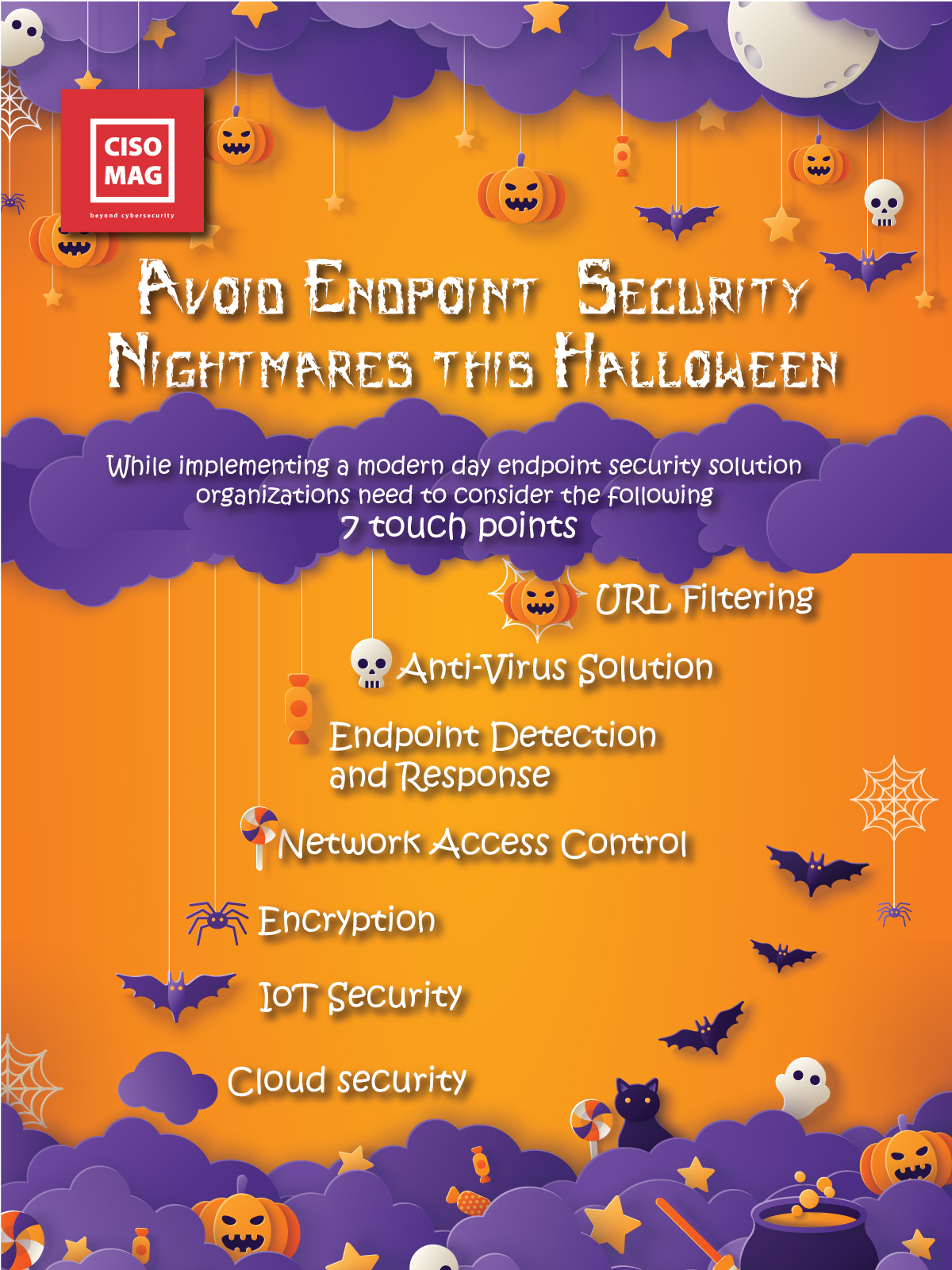
So, before the cyber ghouls in disguise knock on your door, consider these SEVEN touchpoints while choosing an Endpoint Security Solution this Halloween Season.


Endpoint Security Halloween 2020


CISO MAG Endpoint Security SurveySpare a few minutes and take our Endpoint Security Survey as a Halloween treat to help us understand the spooky situation in this domain.

Take the Survey Now!!!