
Home Blog Page 159

How Lack of Visibility Over IaaS Cloud Infrastructure Fuels Cyberattacks

IaaS

The adoption of cloud technologies is more than ever before, and COVID-19 expedited the entire migration process. Cloud security has also taken precedence. Organizations are aware of cloud threats and are trying to make their policies and regulations around it. While several businesses have adopted the technologies to protect their networks and data, it is the processes that are weak. This is where cybersecurity solution providers step in and it has also been an avenue for IaaS for cloud infrastructure. A new report from SailPoint, an identity management firm, has suggested that, in the rush to maintain business continuity, proper management over who has access to IaaS Cloud Infrastructure has slipped for many organizations.

According to the study, 45% Of cyberattacks are fueled by a lack of visibility and control deficiencies relating to the management and access of IaaS infrastructure. The research stressed that organizations are failing to prioritize proper identity governance controls for IaaS like how they are failing to prioritize other key parts of the business, like having proper controls over application and data infrastructure. Out of the surveyed organizations, nearly 74% of companies have more than one IaaS provider with nearly half the companies having more than three.

Due to the increased use of IaaS environments from multiple providers, there has been a heightened difficulty for organizations in keeping tabs on the access. Here, more than two-thirds of organizations rely on multiple tools to try and manage their IaaS environments, causing nearly 97% of organizations to have trouble managing and governing access, making them more susceptible to cyberattacks.

It is indubitable that COVID-10 has accelerated the move to the cloud for many organizations and adoption of IaaS from multiple has helped to match workloads and minimize costs, but the flipside to the sudden rush came at a cost too.

“The move to IaaS has allowed many companies to ensure business continuity whilst working remotely. But with organizations working at breakneck speed to get up and running from home, proper management of who or what has access to multiple IaaS platforms has slipped through the net for many. We are likely to see more security and compliance gaps surfacing, as the compliance damage of this ‘break glass’ moment becomes known,” said Ben Bulpett, EMEA Director at SailPoint.  “Understanding who exactly has access to what, and when, is critical to protect the enterprise network against trespassers. IaaS might be a newer area of the business, but the rule is just as critical here.”

He added, “IaaS is a business-critical technology that speeds up and enables today’s digital organizations; however, without proper governance, this can represent a significant cybersecurity risk. Companies that can extend how they are already governing and managing access to new cloud environments will be well on their way to improving their cybersecurity and compliance posture.”

How AI and Machine Learning Will Transform Risk Management and Compliance

Artificial Intelligence, AL and ML

The unfulfilled past promises of machine learning in risk, compliance, and information security sectors have been disappointing, though understandable. How on earth do you even begin to look at the mind-boggling labyrinth of tens of thousands of compliance provisions and start threading them together to accelerate efficiency? Forget it.

By Andrew Robinson, Co-Founder and the Head of Cyber Security for 6clicks

Now, the change has officially come. So, how did we get to this undeniably exciting point in time – and what does it mean for risk, legal, and compliance professionals?

What was only possible theoretically has become a reality thanks to advances in computing power, capacity, cleverly designed software, and cloud computing storage capabilities accessible thanks to clever API. Let’s start at the first major step that got us here, the cloud.

Compliance and risk management cloud solutions have given us incredible advantages. Data-driven and human-vetted processes have become the new key. This technology does not just collect the information that is being plugged into it by enterprises and consultants around the world, it is learning from it. Cue the sci-fi suspense music?

Relax, It’s Actually Quite Cool

One can easily find SaaS solutions driven by conscientious entrepreneurs with our best interests (and safety) at heart.

The opportunity to now read and understand the current and imminent risk, compliance, and cyber needs are the keys to unlocking better global management and mitigation. The herculean task that was mapping provisions, standards, and regulations to one-another for risk and governance practitioners is over.


– Anthony Stevens, CEO, 6clicks  

Anyone who works in risk and compliance has fantasized about the elimination of repetitive, manual, and tedious tasks. Take those working in large organizations, staring down the barrel of thousands of provisions, taking each standard one by one, tediously achieving compliance, only to face the same nightmare for the next one on the list. No thanks.

Natural Language Learning is Fascinating

Make up your own mind about AI chatbots, but in the compliance world, the maze of provisions issued by regulatory bodies all around the world use different languages that can mean very similar things all the time. And it is slowing us down.

You are already personally benefiting from ML and AI in your home. So why should risk and compliance practitioners not receive the same professional benefits?

The Single Standard Example

In the information security world, it’s likely that you are familiar with ISO/IEC 27001.

Did you know that AI picked up similarities between the mandatory requirement 7.5.3 f) related to “retention and disposition” and Annex A control A.12.3 related to “information backup”?

In the context of documented information, “retention” is required. When we look at operational security as a part of Annex A information “backup” is required. Whilst a human may miss the correlation. Yet, we saw that 6clicks’ AI natural language ML/AI model linked those two together.

Meaning, if A and B are largely the same thing, then the evidence we use to demonstrate compliance to B could be used to demonstrate compliance to A! ML/AI presents this as an incredible opportunity so the “human in the loop” can vet it.

That is just one correlation in a single document! Now, are you ready for this one below?

The Multi-Document Slam Dunk Example

That above example related to “backup” is extremely similar to requirements found in other standards in the NIST Cyber Security Framework, the Australian Signals Directorate’s Essential 8, the Australian Government’s Information Security Manual, the synthesized (but massive) Secure Controls Framework, and many others.

Need I say more to those who have just realized the time and cost savings from this correlation alone? Now amplify the results when this AI/ML natural language feature is running inside a cloud SaaS platform for risk, compliance, and cybersecurity that houses a content library of international standards, laws, and regulations. Are you grinning yet?

Be they local or international, any company or consultancy firm that leverages this type of software has just opened the door to greater proficiency and productivity, as well as more clients and an enormous value proposition. Create more time for the important stuff!


About the Author

Andrew Robinson is a Co-Founder and the Head of Cyber Security for 6clicks. As an internationally recognized cyber and information security expert (policing, intelligence, and counter-terrorism cybersecurity specialist), Andrew has consulted to a diverse range of government and private sector clients around the globe for over 20 years across IT, projects, investigations, telecommunications, energy, legal and financial services.

SPECIAL FEATURES

Disclaimer

Views expressed in this article are personal. The facts, opinions, and language in the article do not reflect the views of CISO MAG and CISO MAG does not assume any responsibility or liability for the same.


Episode #3: How Zoom is Enhancing Security and Evolving its Product

Zoom security

Zoom has now become an integral part of our lives in isolation — for our work, education, or just to meet up with friends and have “Zoom parties.” The pandemic was a blessing in disguise for Zoom and it saw 30X growth in a short span of a few months; before the pandemic, it had 10 million daily meeting participants but by the end of April that number shot up to 300 million. And these are official figures from Zoom.

While those in the corporate world were familiar with the use of Zoom, new users faced “video shock” and were not familiar with concepts like waiting rooms, virtual backgrounds, gallery/speaker views, meeting links, meeting IDs, and passcodes. But today it’s a different story, and we all are more confident in using this tool.

However, Zoom faced a setback earlier this year when its security was compromised leading to “Zoom bombing” attacks.

Thankfully, Zoom worked hard on its 90-day plan to fix those security issues and set up a CISO Council and Advisory Board. It now collaborates with CISOs, governments, and security agencies and experts across the industry to ensure that it is implementing security and privacy best practices. Zoom has also recruited hard-core security experts like Alex Stamos, who joined as an external advisor.

Listening time: 31 mins. 34 sec.

In this episode, Magnus Falk, Zoom’s CIO Advisor – EMEA region updates Brian Pereira, Principal Editor, CISO MAG about Zoom’s new security features like end-to-end encryption. He also talks about the accelerated growth and popularity of Zoom, and how the video platform is evolving.

With over 30 years in the industry, Falk brings a wealth of experience to the table and is an esteemed digital and technology leader.

His diverse experience includes a 16-year stint at Credit Suisse where one of his roles was CIO in EMEA, seven years in Accenture as well as holding the position of Deputy Chief Technology Officer for HM Government.

He has a Bachelor’s Degree in Mining Engineering from Imperial College London and was also a Captain in the British Army for nearly four years.


Listen to our previous podcast episodes here

Threat to Privacy! Corporate Credentials on Darknet Surge by 429%

BLAZINGSUN: A New Breach on Joker’s Stash Dark Web

Security operations provider Arctic Wolf observed a year-over-year decrease in publicly disclosed data breaches. However, in its “2020 Security Operations Report” Arctic Wolf revealed that the number of corporate credentials with plaintext passwords on the darknet market increased by 429% since March 2020.

According to the report, 17 sets of corporate credentials are available on the dark web that could be exploited by cybercriminals to easily execute account takeover (ATO) attacks by obtaining access to one single corporate account. Hackers can also monitor an organization’s corporate network and gain access to sensitive data, intellectual property, competitive information, or funds.

The report also highlighted that most of the high-risk cyberattacks (35%) occurred between the hours of 8:00 PM and 8:00 AM, and 14% occur on weekends, when most internal security teams go offline. “The sharp increase in corporate credential leaks underscores the need for organizations to have dedicated 24×7 monitoring of their network, endpoint, and cloud environments in order to prevent targeted attacks that could happen at any time,” the report stated.

Key Findings:

  • Phishing and ransomware attempts increased by 64%. Hackers have created new phishing lures around COVID-19 topics and adapted traditional lures seeking to take advantage of remote workers.
  • Critical vulnerability patch time has increased by 40 days. A combination of higher common vulnerabilities and exposures (CVE) volumes, more critical CVEs, and the emergence of a remote workforce have significantly slowed the patching programs at many organizations.
  • Unsecured Wi-Fi usage is up by over 240%. Remote workforces connecting to open and unsecured Wi-Fi networks outside of their office or home are now facing increased risks of malware exposure, credential theft, and browser session hijacking.

Mark Manglicmot, Vice-President, Security Services, Arctic Wolf, said, “The cybersecurity industry has an effectiveness problem. Every year new technologies, vendors, and solutions emerge. Yet, despite this constant innovation, we continue to see breaches in the headlines. The only way to eliminate cybersecurity challenges like ransomware, account takeover attacks, and cloud misconfigurations is by embracing security operations capabilities that fully integrate people, processes, and technology.”

“BAHAMUT” Swims into Legitimate Accounts to Spread Disinformation

BazaCall BazaLoader

Security experts from BlackBerry uncovered the cyber espionage group dubbed “BAHAMUT” targeting several government officials and major industries via various disinformation campaigns. In its research “BAHAMUT: Hack-for-Hire Masters of Phishing, Fake News, and Fake Apps,” BlackBerry found that the BAHAMUT group uses various attack vectors ranging from fake news campaigns, fraudulent social media personalities, to the development of entire news websites built to include disinformation.

BlackBerry’s research and intelligence team stated that the BAHAMUT group primarily targets human rights groups, influencers, high ranked government officials, and businesses in India, the Emirates, and Saudi Arabia.

Key Findings:

  • BAHAMUT actors use original, carefully crafted websites, applications, and personas to spread fake content focused on geopolitics, research, industry news about other hack-for-hire groups.
  • Nine malicious iOS applications in the Apple App Store are said to be linked to the BAHAMUT group.
  • Use of phishing and credential harvesting is aimed at very precise targets; concerted and robust reconnaissance operations are conducted on targets before the attack.
  • Clustered targeting in South Asia and the Middle East lends credence to a “hacker for hire” operation.
  • A range of tools, tactics and targets suggests the group is well-funded, well-resourced, and well-versed in security research.

Eric Milam, VP, Research Operations at BlackBerry, said, “The sophistication and sheer scope of malicious activity that our team was able to link to BAHAMUT is staggering. Not only is the group responsible for a variety of unsolved cases that have plagued researchers for years, but we also discovered that BAHAMUT is behind a number of extremely targeted and elaborate phishing and credential harvesting campaigns, hundreds of new Windows malware samples, use of zero-day exploits, anti-forensic/AV evasion tactics, and more.”

“This is an unusual group in that their operational security is well above average, making them hard to pin down. They rely on malware as a last resort, are highly adept at phishing, tend to aim for mobile phones of specific individuals as a way into an organization, show an exceptional attention to detail and above all are patient – they have been known to watch their targets and wait for a year or more in some cases,” Milam added.

Is Security a Blind Spot for Remote Employees?

Remote Work

A survey from cybersecurity firm NetMotion found that the majority of the remote workforce does not report system issues to their IT support team.  The survey findings, based on the responses from 500 IT professionals and 500 remote workers in the U.S. and the U.K., revealed that over 50% of workers admitted that they are not sharing their IT or security issues with their IT team.

While 66% of remote workers reported having faced an IT issue during the lockdown, 57.5% did not share their issues with their organization or IT team.

The survey also highlighted that most employees choose to resolve the issues themselves or choose to suffer in silence, with 25% of workers reporting that their IT department does not value their feedback. While the reason for why employees are doing this is unknown, the survey claims that some employees resolve issues by themselves.

Employees Using Shadow IT

As many remote workers prefer to not report issues to IT teams, the survey suspected that employees have adopted Shadow IT. According to the survey, nearly 62% of remote workers are using rogue applications, with 25% using a significant number of unapproved tools outside of the official IT policy. Only 38% of employees stick to their organization’s list of sanctioned IT software.

The most unsanctioned tools used by remote workers include productivity apps (38%) like Google Docs and Doodle, followed by communications software (32%) like WhatsApp and Zoom.

“It is clear that IT’s lack of complete visibility into the activity of millions of workers, their inability to diagnose all root causes and negative perception among some employee – due in part to unsatisfactory remediator of problems – is a huge part of the burgeoning IT-employee divide. The question thus becomes how to alleviate such constraints when knowing that remote work may be temporary for some but will remain permanent for so many others,” the report stated.

Also Read: CISOs Ignore Security Over Remote Working

Listen to the CISO MAG podcasts to catch the advice and best practices from security leaders.

Don’t Just be a Good CISO, Be a Successful CISO!

Global CISO Forum 2020, Becoming a successful CISO

Up until now, cybersecurity was often an afterthought for several organizations due to lack of mitigation measures. However, COVID-19 is accelerating digital transformation in decentralized locations. The state of security is getting better at building business resiliency, thanks to the evolving role of a CISO. CISOs are the assets and business enablers that give organizations a direction towards a safer and secured work environment. But a CISO’s role is critical in today’s fast-growing digital world. Just being a good CISO is not enough, you need a successful CISO. Why? Because an organization’s success invariably depends on a CISO’s success. So, how do you become a successful CISO? It is a phased process. Let us find out the good, the bad, and the ugly roadmap to success of a CISO from a veteran  CISO, Heath Renfrow

By Mihir Bagwe, Tech Writer, CISO MAG

Speaking at the EC-Council’s Global CISO Forum, Heath Renfrow said, “For too long people have feared us (CISOs) and stayed away from us. We are exactly the opposite of that. We are business enablers! We are there to educate people, tell businesses what their security risks are, and give them advice of how to up their defenses.” Renfrow added, “The success and reputation of an organization largely depends on the security of its employees, systems, and customers. And CIOs/CISOs of that organization have the responsibility of steering this ship.”

Related Story:

“AI has done a good job in securing the dynamic workforce” – Global CISO Forum 2020


Renfrow highlighted the fact that the position of a CISO is like the guy behind the curtains.  They are omnipresent and critical to the entire theatrical of running the business. And just like that guy who does his work in a mechanical manner, taking into consideration all the pros and cons associated with it, Renfrow says that there are five phases that every CISO needs to follow —  to not just be a good CISO, but a successful one.

The Five Phases to Become a Successful CISO

These phases and their respective timeframe differ from one organization to another. However, Renfrow notes that in the two decades of his working career in security, he’s followed this model and has had success across all the organizations he’s served.

1. Phase One: Company Meet and Greet

Global CISO Forum 2020, Becoming a successful CISO

Renfrow has been working in this field remotely for six years now because of the global supply chains of his associations. When you have a global network of employees, vendors, third-party suppliers, and customers, it becomes even more difficult to mark the starting point of this phase. However, this needs to be done and is essential. It is important to know your team and the business leaders, and understand your job profile, which includes definition and maintenance of physical and IT security, privacy and risk management, compliance, and disaster recovery.

Renfrow says, “Now in the COVID age, it is even more difficult to connect with the stretched resources of not just other teams but your own teams as well. We cannot meet them face to face, but we need to connect. Connect via Zoom, Teams, Slack, or any other tool with every important member possible and know what they expect, want, and whether they are happy with their roles. Build a relationship with your team and peers. This will go a long way.”

Renfrow specifically mentioned the need to find a “Cyber Champion.” Identify this person as quickly as possible. This person may not be wearing a cape, but he can be a CISO’s go-to guy who has the answer to all the network and security related queries.

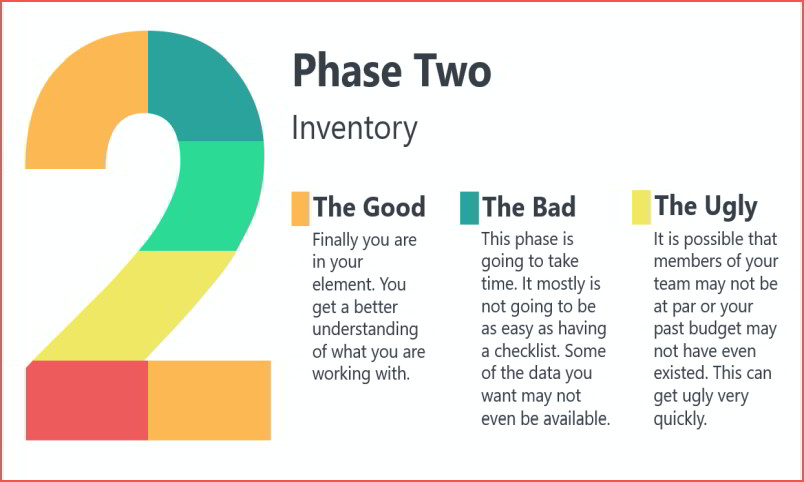
2. Phase Two: Inventory

Global CISO Forum 2020, Becoming a successful CISO

Renfrow quotes, “This could be an extremely time-consuming phase.” Why? Because of the number of people involved in this phase. A carpenter does not straightaway start making a bookshelf or that bunk bed for your kids. He first measures the dimensions of the room; he then decides upon the design taking into consideration his customer’s requirements; prepares a rough inventory of how much ply, varnish, nails and adhesives he requires, then goes and buys it from a third-party vendor, and finally starts preparing the shelf or the bed. If this so-called small piece of work requires so many stakeholders in between, then imagine how many does a CISO needs to interact with for preparing his inventory.

This process, like Renfrow explained, should include the following:

  • Skill sets of people involved (and required)
  • Audits and reports
  • Number of third-party and customer contracts
  • Budget – Past/present, IT and financial
  • Current processes
  • Current security strategies and posture
  • Network and security architectures in place
  • Regulatory and compliance requirements

3. Phase Three: Assessment

Global CISO Forum 2020, Becoming a successful CISO

It’s now time to prepare your to-do list. This is the phase where you sit back and assess your findings from the inventory phase and measure your organization’s security posture. Prepare a list of pros and cons of the various systems, processes, and strategies in place. Now understand the requirements of your business and its shortcomings.

Renfrow says that he has seen organizations having a lot of security tools but also found a shortage of skilled people manning these tools. In some cases, he also observed that certain security tools were implemented for specific tasks but 80% of  those tasks were being carried out by some other tool or manually by a person. Thus, there is a need to sit back, assess the ground reality against the actual requirements based on the findings of the first two phases, and then prepare a to-do list or the action plan to move forward.

Considerations for this stage include:

  • Review of technical requirements
  • Reviewing performance metrics
  • Assessment through a specialized third-party assessor
  • Review of vulnerability and penetration testing reports

4. Phase Four: Planning or Building a New Vision

Global CISO Forum 2020, Becoming a successful CISO

This is where you put your challenges into vision, says Renfrow. Understanding challenges like poor support, security governance, or compliance and audit gaps is very important. You may have support from the business team but maybe not from your executives or vice versa. You might have spent a lot of time in the first two phases by communicating, educating, and convincing your peers, but this can hamper your operations and can be a huge challenge to overcome.

At the same time, this is the phase where you must cross another impediment that CISOs face – the Budget. Based on the assessment done in the previous phase, it is quite clear what you need for taking your organization’s security game to the next level. So, start deducing a budget which can be presented to the business leaders in the next phase. Renfrow also suggested keeping this as a variable budget. Based on the risk decisions taken by the business leadership, the budget may swell.

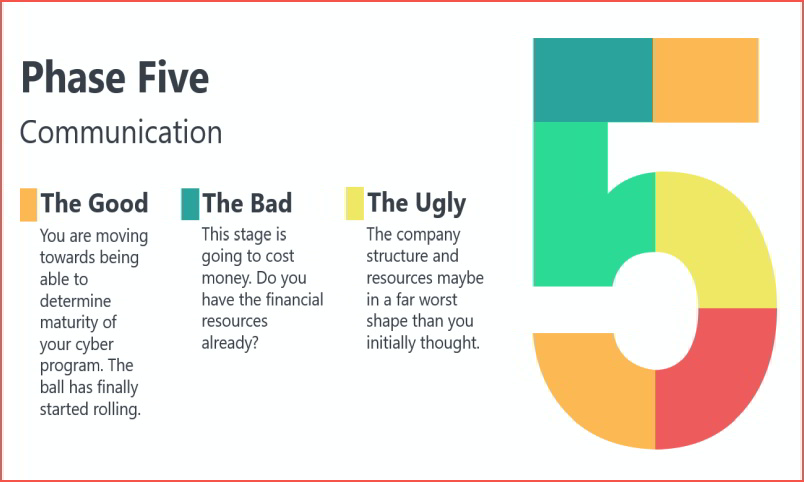
5. Phase Five: Communication

Global CISO Forum 2020, Becoming a successful CISO

Time to roll out that carpet, sit across the table, check those microphones, and talk! We have already built the vision in the last phase as to where our organization’s security posture needs to be against where it currently is. Now sit across the table to educate and make the business leaders understand what you have analyzed and what is the way forward on the security front.

According to Renfrow, another key element of this conversation is presenting business leadership with quantifiable risk analysis. The top suite better understands the language of numbers and statistics than just being presented with grey zones. Some methodologies like the Factor Analysis of Information Risk (FAIR) can come handy in doing so. It helps in establishing accurate probabilities of the frequency and magnitude of the risks.

And finally, it is time to discuss the Budget! Renfrow says, “You have laid the vision, shown the gaps, quantified the risks, and gotten the risk tolerance sorted for those risks. Just one thing remains, adjust your budget vision, take approval, and get out of that room!” Yes, it will be a difficult conversation, and you will be bombarded with tough questions and choices but remember the title of this phase – Communicate. You need to convey and convince your case. After all, the tag of being a successful CISO is a hard-earned one and lies just at the other end of this conversation.

6. About Global CISO Forum

Global CISO Forum

Global CISO Forum is an annual event that sees a confluence of the highest-level executives from across industries and countries who discuss the most pressing issues in information security. Now in its tenth year, the 2020 Global CISO Forum promises to be the best yet with an exciting mix of industries, formats, and interactive presentations.

In celebration of our 10 years of CISO events, EC-Council is giving its brand-new Risk Management Approach and Practices e-book to all attendees of the Global CISO Forum! Risk is at the heart of what a CISO does and EC-Council wants to create as many risk-smart executives to protect the world’s assets as possible.

EC-Council’s Global CISO Forum 2020 Virtual Conference was an invite-only, closed-door event gathering.

CISO MAG is the Content Editorial Sponsor for the Global CISO Forum.


U.K. Businesses Suffered a Cyberattack Every 45 Sec. During Lockdown!

cyberattacks on U.K. organizations

A research from business ISP provider Beaming revealed that the number of businesses in the U.K. that are affected by cyberattacks has increased after the country went into lockdown. The organizations suffered over 177,000 targeted attacks between April and June 2020, which means one cyberattack every 45 seconds.

While the volume of attacks increased by 13% in the first quarter of the year, the research revealed that cybercriminals used 3,41,000 unique IP addresses to attack businesses in the second quarter of 2020. It is found that 37,000 of these addresses were traced back to different locations in China, 32,000 in Taiwan, and 17,000 in the U.S.

The research also highlighted the volume of cyberattacks targeting file-sharing applications surged by 27%, accounting to 5,900 attacks per company. In addition, IoT applications like building control systems and networked security cameras remained the most common targets for threat actors, accounting to more than 14,000 online attacks per company.

Sonia Blizzard, Managing Director of Beaming, said, “We’ve all relied more on the internet to work, shop and communicate in the past few months, and our analysis shows that due to this change in circumstances this environment hasn’t just become busier – it’s required us to better protect ourselves too.”

“Businesses of all sizes need to take action today to improve their resilience to cyberattacks and keep their employees and data as secure as possible. Leaders must think beyond the basic protection most have today and boost business resilience with more sophisticated defenses that incorporate technology, training, and robust security policies,” Blizzard added.

U.K. Organizations Lost $108 Bn to Attacks

Earlier, Beaming claimed that the number of businesses in the U.K. affected by cyberattacks has doubled since 2015. The five-year cybersecurity research stated that 1.5 million businesses (25%) in the U.K. suffered cyberthreats in 2019, compared to 7,55,000 businesses (13%) in 2015, costing them £87 billion (US$ 108 billion). The research also highlighted that large-scale businesses were the most affected, with 9 in 10 companies (87%) reporting cyberattacks. Small and Medium Businesses (SMBs) have seen the steepest rise in attacks, compared to 28% of firms hit in 2015, to 62% in 2019.

Market Trends Report on Data Security – 2020

Data Security Report

Organizations around the globe are investing heavily in the cybersecurity quotient of its IT infrastructure to protect their critical assets. Arguably, with the unprecedented shift towards digitization and cloud technologies, data in any form is now considered “the new oil.” A 2019 Netflix documentary, “The Great Hack,” declares that personal data has surpassed oil as the world’s most valuable asset. It warned viewers that companies and governments are hacking more than computers, “it’s our minds that they are into.” CISO MAG editors wanted to probe deeper and offer its readers perspectives on the state of Data Security.

Data needs to be protected at rest, in transit, and even while it is being processed in memory. Today, GDPR, CCPA, and other regulations make data protection mandatory. Organizations have a responsibility to protect customer data, personally identifiable information, confidential data, intellectual property, and transactional data. Governments need to protect state secrets. Data sovereignty and data residency are on the compliance checklist.

CISO MAG 2020 Market Trends Report on Data Security - 2020

Governments, CISOs, and CDOs (Chief Data Officers) must take a holistic approach and ensure Data Security, Data Governance, and Data Integrity through compliance and policies. They must ensure that data access is strictly on a need-to-have basis. These are the tenets for customer trust, loyalty, and the reputation of an organization.

Data has become worthy, smart, and intelligent, however, with every set of pros come the cons. This CISO MAG Market Trends Report 2020, brings to the fore a viewpoint of the industry experts and their perspective from across the table.

To view the complete analysis and reportage, hit the download button now!

CISO MAG 2020 Market Trends Report on Data Security - 2020

Here’s the Top Security Threat for Educational Institutes

Institutes cyber security

A survey from cybersecurity firm Netwrix revealed that most educational institutions have become increasingly concerned about cyberattacks after the transition to online learning due to the pandemic. The survey “2020 Cyber Threats Report” sheds light on how the outbreak and e-learning initiatives changed the cybersecurity risk landscape.

According to the survey, over 33% of respondents said they are more vulnerable to cyberattacks than they were pre-pandemic. Nearly, 89% of them admitted they identified new security gaps due to the rapid transition to remote education, which is the highest finding among all sectors.

Key Findings:

  • Around 92% of educational organizations consider inappropriate data sharing to be a top security risk. While 41% of respondents reported that they had suffered such incidents in the first few months of the pandemic, making it one of the most common threat scenarios experienced. Other types of incidents reported included phishing (50%) and administrator mistakes (31%).
  • 78% of the educational institutions said they are at greater risk now than before the pandemic and are concerned that users may ignore security guidelines.
  • Concern about malicious actions by rogue admins dropped from 92% to 9%. Indeed, only 12% had such incidents, but they had the longest dwell time, 43% of respondents needed weeks or months to detect the issue.
  • Every fourth educational organization experienced misconfiguration of cloud services in the first few months of the pandemic.

“To minimize the risk and impact of human errors, we recommend investing in security training and easy-to-use collaboration tools. The latter will eliminate the temptation to share sensitive records through unsanctioned solutions, while giving the IT team enough control and auditability. Also look for ways to leverage automation to augment the IT team’s efforts. For instance, data classification will help them focus their security efforts on the most critical data, while automating audit trail collection and analysis will enable them to detect and investigate incidents faster,” recommended Ilia Sotnikov, VP of Product Management at Netwrix.

Cyberattacks on E-Leaning Platforms

There has been a surge in the usage of online learning platforms during the pandemic, which also attracted the cybercriminals to launch their malicious acts. In the recent past, hackers targeted multiple e-learning portals to steal users’ personal information. India-based online learning platform Unacademy suffered a data breach that exposed details of 22 million users. Cybersecurity firm Cyble revealed that the unknown hackers kept 21,909,707 user records for sale at $2,000 on darknet forums. The compromised information included usernames, hashed passwords, date of joining, last login date, account status, email addresses, first and last names, and other account profile details. Earlier, a Spanish e-Learning platform 8Belts suffered a data breach that exposed personal data of over 100,000 e-learners across the globe.