
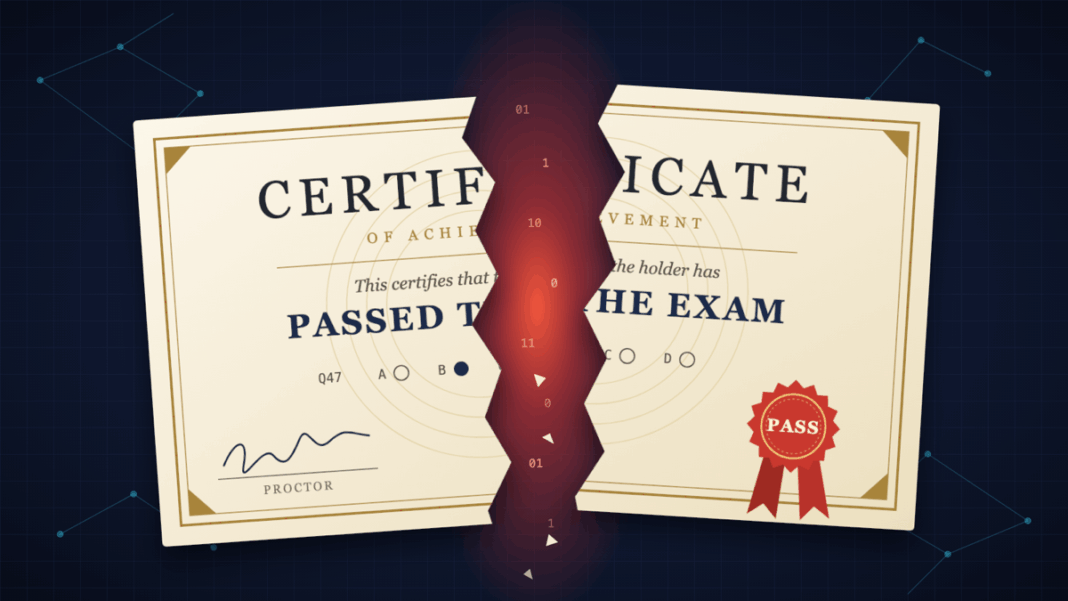
Passing an exam and being able to do the job are two different things, and both certification prep and introductory college courses tend to reward the first one.
By Dr. Frankie Grullon, Level 9 Corporation (www.level9c.org), a 501(c)(3) nonprofit organization
I have worked with a lot of cybersecurity students, and one pattern keeps showing up no matter where they are studying or which certification they are chasing. A student will study for an exam, pass it, and in a lot of cases still not be able to explain what the material means once they are sitting in front of a real system. Some of them understand it and others memorized just enough to get through, but on paper those two groups look exactly the same.
And the cost of that is showing up in the data. In the 2025 ISC2 Cybersecurity Workforce Study, 88% of respondents said a skills shortage had caused at least one significant cybersecurity consequence in their organization (ISC2, 2025), and when ISACA asked what makes a candidate qualified, prior cybersecurity experience came in at 60%, just behind adaptability at 61% (ISACA, 2025).
How students prepare for certification exams
Most certification exams check foundational knowledge, and they do a decent job of giving everyone a common baseline. The problem I keep running into is how students prepare for them, which is usually to cram, memorize enough to recognize the right answer, pass, and move on.
Roediger and Karpicke (2006) found that students who restudied a passage did better on a test five minutes later, but the students who practiced recalling it remembered substantially more after two days and after a week. Ebbinghaus described the forgetting curve in the 1880s, a modern replication found that it still holds (Murre & Dros, 2015), and students have been proving him right every exam season for about 140 years.
So what you end up with is a credential that captures what someone knew on the day of the test. As an example, a student can tell you which port DNS runs on and still have no idea why it matters when DNS traffic starts leaving the network at 3 a.m. Anyone who has worked in IT knows the haiku that goes “It’s not DNS. There’s no way it’s DNS. It was DNS,” and a lot of these students have not been through enough outages yet to understand why that one hurts.
The same incentive in foundational college courses
Academia has its own version of this. Introductory courses are built to move a lot of students through a fixed amount of material, and faculty are measured in part on pass rates and student evaluations, so the incentive is to get students through with a basic understanding that usually is not enough to start working in the field.
Carrell and West (2010) saw this at the U.S. Air Force Academy, where students are randomly assigned to professors who use the same syllabus and exams. Students of introductory math professors whose sections did well performed significantly worse in the follow-on courses, and student evaluations predicted current grades but not later ones. On top of that, when a professor walks students through a configuration step by step, it feels like understanding while it is happening, and students tend to overestimate how much they actually learned (Bjork et al.,2013).
Making students build things
Some universities are starting to address this by having students build their own applications, labs, and environments. When a student has to stand up a network, break it, and figure out why it broke, they are doing the problem solving that cramming skips. A meta-analysis of 225 studies found that students in traditional lecture courses were 1.5 times more likely to fail than students in active-learning courses (Freeman et al., 2014), and in cybersecurity, undergraduates who took part in capture-the-flag exercises reported more engagement and more confidence in their skills. (Leune & Petrilli, 2017).
What students need to do differently
Universities can only do so much, and part of this has to come from the students. The biggest concern I see is that some students, and not all of them, expect a traditional program to walk them to the finish line, and that cannot happen in this field anymore. If someone wants to work in IT or cybersecurity, they need to actually be interested in the material, and that usually means going through some trial by fire.1
As an example from my own experience, I had students who were told to study around 20 hours a week, including lab practice, so they would be ready for the exam and for an introductory-level course. What was actually happening is that many of them were spending more like 4 to 6 hours a week speed reading the material to get past their checkpoints and on to whatever came next, right?
So my advice to students is to ask themselves the harder question early, which is if I go into the industry tomorrow, am I actually ready to do this? They should also be asking their professors questions early and often instead of waiting for the end-of-course evaluation, when nothing can change for them. A few I would start with:
- How would this show up on the job for someone at the entry level?
- Where can I practice this outside of class?
- Here is how I worked through this, so where does my understanding break down?
Outside of class, they should be doing their own research with YouTube, Wikipedia, vendor documentation, and open-source tools, because almost everything they need is public, and 87% of YouTube users say the site is important for learning to do things they have never done (Smith et al., 2018). If a student is chasing the paper, I am not going to judge them for it, but they need to be ready for the repercussions, which usually means a much larger round of skills training after they finish their degree. I end up having that conversation with students often.
What security leaders can do
CISOs and senior leaders need to understand that this is what the talent pool looks like right now. Unless an organization has a robust onboarding and training program that verifies skills, it should not hire anyone on the basis of a certification alone. The exception is when a certification is an absolute requirement, as it is for many federal information systems and positions under DoD Manual 8140.03 (U.S. Department of Defense, 2023), and even then the hands-on verification still has to happen. A few things I would recommend:
- Ask candidates to show you something they built, like a home lab, a code repository, or a capture-the-flag write-up, and add a short hands-on exercise to the technical interview.
- Give junior staff regular lab time and tabletop exercises so the learning does not stop at the credential.
AI is an extremely attractive option right now, but it behaves a lot like these new students, where it assumes a lot and does not provide much
context for how it got to its answer. Replacing positions with AI is probably not the best executive decision, and the leaders who do it anyway may end up as the dog in the “this is fine” meme, sipping coffee while the room catches fire. That is a different conversation, though.
None of this means certifications or degrees are worthless, because they are a good starting point, but the skills gap only starts to close when students, universities, and employers all expect people to show what they can do as opposed to what they memorized for a test.
1Students should not expect the instructor teaching a course to make sure they formally understand everything in it, because the expectation is that they are doing their fair share of the work. The federal definition of a credit hour assumes at least two hours of out-of-class work for every hour of instruction (Definitions, 2026), which comes out to about six hours a week for a three-credit course. Full-time students reported about 27 hours a week on class and studying combined in 2003, down from 40 in 1961 (Babcock & Marks, 2011).
References
Babcock, P., & Marks, M. (2011). The falling time cost of college: Evidence from half a century of time use data. The Review of Economics and Statistics, 93(2), 468–478. https://doi.org/10.1162/REST_a_00093
Bjork, R. A., Dunlosky, J., & Kornell, N. (2013). Self-regulated learning: Beliefs, techniques, and illusions. Annual Review of Psychology, 64, 417–444. https://doi.org/10.1146/annurev-psych-113011-143823
Carrell, S. E., & West, J. E. (2010). Does professor quality matter? Evidence from random assignment of
students to professors. Journal of Political Economy, 118(3), 409–432. https://doi.org/10.1086/653808
Definitions, 34 C.F.R. § 600.2 (2026). https://www.ecfr.gov/current/title-34/subtitle-B/chapter-VI/part-600/
subpart-A/section-600.2
Freeman, S., Eddy, S. L., McDonough, M., Smith, M. K., Okoroafor, N., Jordt, H., & Wenderoth, M. P. (2014).
Active learning increases student performance in science, engineering, and mathematics. Proceedings of the National Academy of Sciences, 111(23), 8410–8415. https://doi.org/10.1073/pnas.1319030111
ISACA. (2025, September 29). New ISACA study: Despite understaffed cybersecurity teams, fewer enterprises
are training staff for security roles [Press release]. https://www.isaca.org/about-us/newsroom/pressreleases/2025/state-of-cybersecurity-2025-global-press-release
ISC2. (2025, December 4). ISC2 publishes 2025 cybersecurity workforce study. https://www.isc2.org/Insights/2025/12/ISC2-publishes-2025-cybersecurity-workforce-study
Leune, K., & Petrilli, S. J. (2017). Using capture-the-flag to enhance the effectiveness of cybersecurity
education. In Proceedings of the 18th Annual Conference on Information Technology Education (pp. 47–52). Association for Computing Machinery. https://doi.org/10.1145/3125659.3125686
Murre, J. M. J., & Dros, J. (2015). Replication and analysis of Ebbinghaus’ forgetting curve. PLOS ONE, 10(7), Article e0120644. https://doi.org/10.1371/journal.pone.0120644
Roediger, H. L., III, & Karpicke, J. D. (2006). Test-enhanced learning: Taking memory tests improves longterm retention. Psychological Science, 17(3), 249–255. https://doi.org/10.1111/j.1467-9280.2006.01693.x
Smith, A., Toor, S., & van Kessel, P. (2018, November 7). Many turn to YouTube for children’s content, news,
how-to lessons. Pew Research Center. https://www.pewresearch.org/internet/2018/11/07/many-turnto-youtube-for-childrens-content-news-how-to-lessons/
U.S. Department of Defense. (2023). Cyberspace workforce qualification and management program (DoD
Manual 8140.03). https://www.esd.whs.mil/Portals/54/Documents/DD/issuances/dodm/814003p.PDF