By Jeremy Hehl
Agents can triage, enrich and correlate at machine speed. But someone still has to own the risk call. On Episode 18 of EC-Council’s The Cybersecurity Podcast, Foresite Cybersecurity’s Jeremy Hehl tells host Jay Bavisi why the fully autonomous SOC is further off than vendors suggest, and why governance is the next real frontier.
Every security operations center now claims to be “AI-powered.” For MSSPs, saying anything else risks being labeled old school. So what does an agentic AI SOC actually look like in production?
Jay Bavisi, founder of EC-Council and host of The Cybersecurity Podcast, put that question to Jeremy Hehl, Chief Cybersecurity Evangelist at Foresite Cybersecurity, where he leads the company’s Google SecOps partnership. Their 40-minute conversation covered the limits of autonomy, the future of the SIEM, the fate of L1 analysts, ISO 42001, and the post-quantum risk that keeps Hehl awake at night.
Agents compute, humans decide
Hehl sees real promise in autonomous security operations. Investigation, triage, data aggregation, enrichment and correlation can already be handled by agents “pretty seamlessly,” he said. The hurdle is risk determination: deciding whether something actually matters to the business.
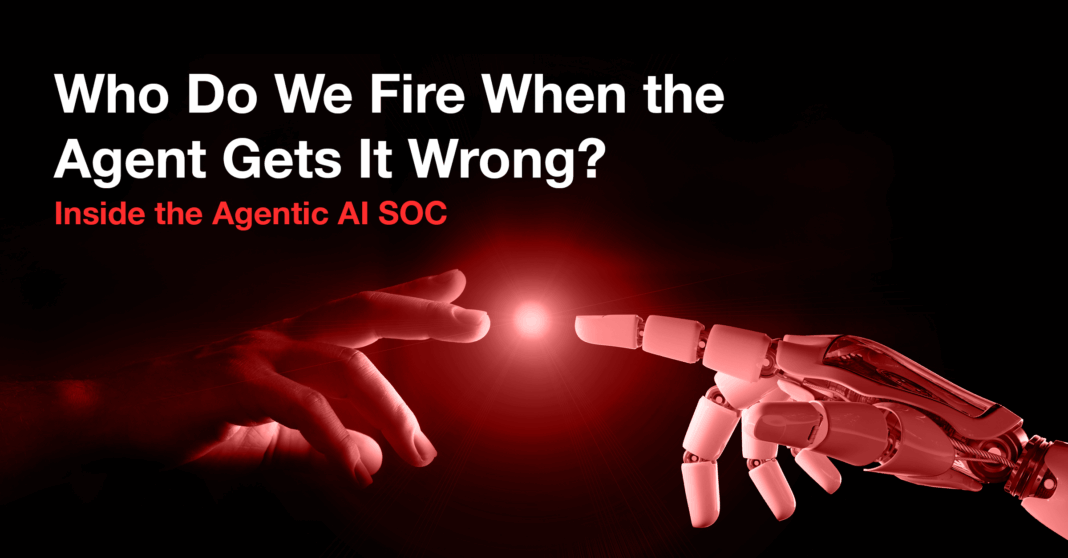
“The question I always ask customers who come to us and say that they want a fully autonomous SOC is: who do we fire when something goes wrong? Do we just dismiss the agent?”
Foresite’s approach treats agents as force multipliers rather than replacements. Hehl compared it to handing analysts a tricorder, a tool that scans and characterizes a threat instantly so the human can decide what to do. Bavisi summed up the model as “agents compute, human decides,” and Hehl agreed, adding that the risk call is the deciding factor.
Is the SIEM on borrowed time?
Asked why Foresite’s Google work matters when most premier SIEMs already ship with AI built in, Hehl pointed to a coming paradigm shift in where data lives. Data sovereignty, regulated industries and ever-growing telemetry volumes are straining the traditional model.
Today, a SIEM aggregates logs into a central plane, normalizes them into fields, and runs detection logic over the result. Hehl expects that to change. Logs will increasingly stay where they reside, in a hyperscaler such as Google, Azure or AWS, and agents will synthesize the raw telemetry in place.
“The idea of a SIEM may become something that is deprecated pretty rapidly.”
He likened the economics to cell phones in the 1990s, when minutes and text messages became commoditized. Data storage will become an assumption, and providers will bill for agent activity and “token burn” instead. Keeping telemetry in BigQuery, he noted, is far cheaper than keeping it hot in a separate SIEM. “The technology has to support it, and we’re not quite there yet,” he added.
The platform is also open by design. Foresite builds primarily on Google’s Vertex AI and Gemini, but Hehl said almost any model, including Claude, can be wired in through APIs and credentials. Agents are, in effect, privileged users, though wiring in other models takes real engineering, parsing and upkeep.
Is the SIEM on borrowed time?
Bavisi raised a trend seen worldwide: L1 roles vanishing, then L2, leaving only L3. Is that simply where agentic technology is heading?
Hehl said Foresite’s experience runs the other way. “We haven’t eliminated jobs. We’ve only grown,” he said. Adding agents to triage, threat hunting and analysis has let analysts handle 10 to 15 times the workload. They dismiss false positives quickly and spend the time saved on learning and more meaningful work.
He invoked the Industrial Revolution in England and France, when coal-powered textile machinery drew a Luddite backlash and even riots. Over time, workers using the machines became far more productive, and business owners demanded more output. This is the pattern known as Jevons Paradox, and Hehl sees agentic AI in the SOC following the same path.
Having started his own career red-teaming banks and working in a SOC, Hehl knows the burnout of triaging the same alert queue “over and over and over again.” Agents that correlate alerts into single cases, surface heuristic patterns and flag statistical outliers do that work “really, really well,” he said. The drudgery goes away; the analyst does not.
The few vendors promising fully autonomous SOC operations, he added, are narrow and tightly focused. Agents that reach a decision and enforce an action must be rigorously tested and simulated, and without clean data they hallucinate. Removing human control over security posture “is pretty unlikely in the next decade or so.”
Taming a non-deterministic technology
Bavisi pressed on a core engineering problem. Ask a frontier model the same question five times and you may get five different answers. How do you build a SOC on that without hallucinations and with consistent results?
Hehl’s answer: a measured, staged deployment. Start with narrow, targeted use cases where machines clearly beat humans, such as data manipulation, API access, running queries and writing code. Then build up capability and maturity step by step.
In enterprise engagements, Foresite first gets data normalization to “basically four nines.” Only then do agents go into the automation playbooks. Hehl argued that calling an agent today is not much different from calling a cloud function that once sat as Python inside a SOAR playbook.
“If you set up markdowns and guidelines and files and restrict the identity of the agent to only do very prescriptive things, as opposed to being all-encompassing, those are the outcomes that customers are looking for.”
He also described three types of MSSP customer. Some just want their brand and stakeholders protected. Some want an extension of their blue team bench. Others come to learn the “massive wall of knobs and levers” in Google’s security portfolio. Mid-market and SMB clients mostly treat agentic capability as part of the service. Enterprises usually already run agents elsewhere in the business and need a careful path to using them for security.
Governance: the next frontier for MSSPs
The industry has swung from “fire all humans and buy all the tokens” to “fire all the tokens and hire all the humans,” Bavisi observed, and is now wobbling in the middle. Where does AI governance fit for customers?
Hehl called it “the next real frontier” for managed security providers, with ISO/IEC 42001 emerging as the benchmark in the US. As public sector bodies adopt hyperscale platforms with agentic capabilities built in, they will need observability into what fleets of agents with permissive access are doing and saying to each other. That raises hard questions: where the harness sits, what protocols apply, and how to read intent from prompts and agent behavior.
“There’s a difference between an agent that sits there and does a prescriptive task … and when we start allowing agents to quantify risk and call other tools.”
He cited Wiz, which maps every model and agent in an environment and the lines of communication between them, and partner Safe AI for observability of agent activity. The CISO’s real dilemma, he said, is simple: “I’m being told I have to deploy AI. I am deploying AI. How do I secure this?”
The forgotten middle
Bavisi divided the world into three tiers. The top 5%, such as Google, Salesforce and Microsoft, have ISO 42001, red teams and consultants. At the other end are organizations that think two ChatGPT subscriptions make them an AI company. The vast majority sit in the middle. They know AI is more than chatbots but don’t know how to adopt, defend or govern it, and they cannot afford tier-one observability tools that may cost a million dollars.
How, he asked, should a business in Hokkaido, Jordan or New Zealand handle intent drift, blast radius, agent-to-agent communication and the transfer of governance between agents?
Hehl noted a related trap. Niche AI startups often build a narrow agentic product, only for the next frontier model or hyperscaler update to build that feature in and make the company irrelevant. For the mid-market, he argued, the answer is partnership: managed providers that deliver governance and observability as part of the service, “a Sherpa through the valley.”
Having ISO 42001 vs. living it
Bavisi pointed out that ISO 42001 has more than 190 controls, and as with ISO 27001, holding the certificate and operating by it are two different things. Do organizations show compliance for regulators while running with serious gaps?
“All the time,” Hehl said. Agentic adoption remains limited in US classified environments (IL-4 to IL-6) and in multinational bodies such as the European Space Agency, a Foresite client. In the commercial world, the most governed vertical with the largest gap is healthcare and life sciences, which holds sensitive patient data and research.
His prescription is to move telemetry into the cloud. Once workloads move from physical data centers into a hyperscaler, “the policies are native by default. And when agents are deployed, they’re governed by default.” The next big push, he said, is identity and privileged access management for agents, treating them as users. Bavisi added temporal context as another layer to solve.
Consolidation, and a $250,000 query
Bavisi argued the industry has a duty to bring along the businesses “where the actual civilization exists.” How? Hehl’s one-word answer: consolidation.
By around 2035, he expects hyperscalers such as Google, Microsoft and AWS, along with CrowdStrike, Palo Alto Networks, Cisco and to some extent Oracle, to keep absorbing companies and technologies. That will make enterprise-grade tooling usable by businesses of every size from one platform. Startups will keep flourishing, and Israeli startups will stay disruptive, but Hehl predicts acquisition values will fall as vibe coding lets almost anyone build a product. He also sees Chinese and Indian AI models closing the gap with American ones, with major implications for global security over the next 20 years.
On Anthropic’s Mythos, Hehl was blunt: it is “the greatest sales tool ever created.” It has stirred fears of boogeyman vulnerabilities, but he said it is genuinely capable of discovering zero-days and attack paths that need fixing. That in turn creates business for defensive tools such as Google’s CodeMender. None of it changes the basic discipline: find attack paths, shore them up, test, repeat. “We’re never really more than 99% of the way there.”
The other barrier for the middle market is cost predictability. Token-based pricing is not yet predictable. Hehl admitted Foresite once ran an accidental $250,000 query on Gemini during iterative testing and had to ask Google for forgiveness. Predictable pricing, he said, is what will let more customers lean in.
What really blocks the move to AI-era security
Asked about the biggest obstacle to moving an organization from traditional security to an AI-era culture, Hehl named three:
- Financial opacity. Customers lack transparency on what AI will actually cost.
- Unclear goals. Organizations often lack a clear picture of what they want AI to achieve, which calls for education and enablement.
- Reluctance to hand over control. Teams that have built careers around a security posture over the past decade ask why they should introduce new pain when nothing hurts now.
Winning them over is part of the “trust motion,” he said, and some will never make the shift because of requirements that keep them where they are.
Machine-speed attacks and a post-quantum dam
What keeps Hehl up at night is machine-speed attacks, which he said “are absolutely accelerating,” and frontier models built explicitly to break software and create new attacks. Beyond that is the prospect of cryptography being cracked faster than it can be rotated.
Bavisi shared the concern. He sees cracks already forming in encryption and fears the day “the dam breaks, and we’re not ready for a PQC world.” Hehl pointed to the downstream effects on blockchain, financial systems and energy grids, and the limits of what any single defender can do.
“There’s nothing we could do as an MSSP or a security practitioner to reset global cryptography … to reset the keys that we hold dear in order for us to maintain those chains of custody, privacy, and command over those systems.”
The takeaway from the conversation, Bavisi said in closing, is that the agentic SOC “is not just in the labs. It’s already in production.” The open question is whether governance, cost models and the cryptographic foundations underneath can keep up.

Jeremy Hehl, Chief Evangelist at Foresite Cybersecurity
Jeremy Hehl is Chief Evangelist at Foresite Cybersecurity, a Google Cloud Premier Partner and the 2026 Google Cloud Security Partner of the Year.